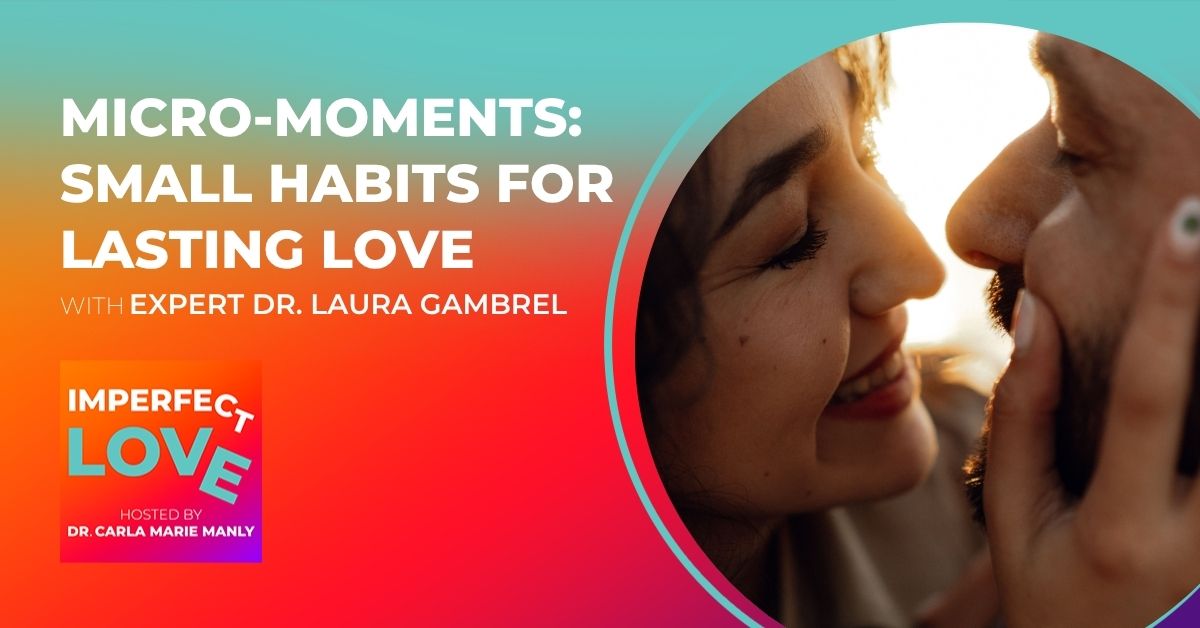
Are you constantly yearning for a deeper connection with your partner? Do you tend to feel that your mate is disinterested in what’s going on in your inner or outer world? Common issues like these leave many romantic partners feeling dissatisfied with the quality of their intimate relationships. And when parenting, family, and work issues arise, the sense of disconnection can get far worse–and even lead partners into going their separate ways. Yet I’ve found that many relationships can be resuscitated–and made stronger than ever–when partners invest in mindful emotional connection. Today, we’re joined by a top relationship expert, Dr. Laura Gambrel, who will guide us into powerful world of EFT, Emotionally Focused Therapy, to help you get the loving connection you crave!
Topics discussed include love, relationships, marriage, children, stress, societal messages, emotional availability, emotional connection, secure attachment, attachment style, insecure attachment, avoidant attachment, anxious attachment, compliments, positive reinforcement, shame, curiosity, suffering, individual therapy, self-growth, and couples therapy.
Please note that this episode contains sensitive material; listener discretion is advised.
Emergency Assistance Details: If you or someone you know needs immediate support, please call your emergency services. In the US, 24/7 help is available by calling “911,” “988” (Suicide and Crisis Hotline), or SAMSA (Substance Abuse and Mental Health Services Administration) at 1-800-662-HELP (4357). As applicable, additional resources may be provided in the show notes.
Non-Emergency Online Mental Health Information: https://www.nami.org/support-education/nami-helpline/
and https://odphp.health.gov/myhealthfinder/healthy-living/mental-health-and-relationships
IMPORTANT DISCLAIMER: No expert is offering medical or psychological direction or advice; the content is purely informational in nature. Please consult your physician or healthcare provider before undertaking any new regimen or procedure.
Connect with Dr. Carla Manly:
Website: https://www.drcarlamanly.com
Instagram: https://www.instagram.com/drcarlamanly/
Twitter/X: https://www.twitter.com/drcarlamanly/
Facebook: https://www.facebook.com/drcarlamanly
LinkedIn: https://www.linkedin.com/in/carla-marie-manly-8682362b/
YouTube: https://www.youtube.com/@dr_carlamanly_imperfect_love
TikTok: https://www.tiktok.com/@dr_carla_manly
Books by Dr. Carla Manly:
Joy From Fear: Create the Life of Your Dreams by Making Fear Your Friend
Date Smart: Transform Your Relationships and Love Fearlessly
The Joy of Imperfect Love: The Art of Creating Healthy, Securely Attached Relationships
Imperfect Love Relationship & Oracle Card Deck by Dr. Carla Manly:
Connect with Dr. Laura Gambrel:
Website: http://www.relational-mindfulness.org/
LinkedIn: http://www.linkedin.com/in/gambrel
—
Listen to the podcast here
Micro-Moments: Small Habits for Lasting Love
Are you constantly yearning for a deeper connection with your partner? Do you tend to feel as if your partner is disinterested in your inner or outer world? Common issues like these leave many partners feeling chronically dissatisfied with the quality of their intimate relationships. When children, family, and work issues arise, the sense of disconnection can get far worse and even lead partners into going their separate ways.
Understanding the EFT Process
Yet, I have found that many relationships can be resuscitated and made even stronger than before when partners invest in mindful emotional communication and connections. In this episode, we are joined by a top relationship expert who will guide us into the power of EFT or Emotionally Focused Therapy. She will offer tips that you can use in your own relationships.
We will focus on this reader’s real-life question, “I love my partner, but we just don’t connect on an emotional level. My girlfriends have the same issues with their partners. They just want to talk about surface things. I have two questions. 1) Are men just not equipped or interested in deep relationships? Are they wired that way? 2) Is there anything I can do to get my partner to want to have more than a superficial and sexual relationship with me? Do I need to just accept him as he is?” With that issue as the focus of this episode. I’m Dr. Carla Manly and this is Imperfect Love. Please note, as this episode contains sensitive information. Listener discretion is advised.

I’m truly excited to be joined by a top relationship expert, Dr. Laura Gambrel. Laura is a Psychotherapist, Researcher, Supervisor, and Author who has decades of experience working with couples and as a trainer of psychotherapists. Welcome to the show, Dr Laura. It’s such a delight to have you with us.
Thank you. I’m so excited to be here.
Thank you for taking your time. I know you have a busy schedule. Introducing you, I’m thinking, “You’re a psychotherapist. You are a researcher, a teacher and educator of clinicians who want to be EFT psychotherapists. You’re also a mom, among other things.” You have a full plate, don’t you?
I do have a full plate. One of the things that helps that work for me is I’m passionate about all those things. That’s that difference between being burned out, stressed, being energized and passionate, is I love all those things. It helps me stay energized.
It’s a beautiful way of looking at it because when we’re passionate about something, it doesn’t feel so much like a drain or stress. There can be times it makes us tired. When we’re passionate about it, it’s like a labor of love. Thank you for that. Before we dive into this question, would you tell our readers a little bit or a lot about what makes you, you?
That’s such a beautiful question. Ever since I was a kid, my mom always tells a story about how I was one of those kids who was always asking why like, “Why this? Why that?” I’ve always just been fascinated by how things work and figuring stuff out. That’s been my whole life. Once I happened upon psychology in high school, started reading books and getting interested in people, neuroscience, and psychotherapy, I became fascinated about how people work.
What happens inside of people and what happens between people. As I went through my journey in getting trained and became a marriage and family therapist, I started looking at how the systems interact and how do people come to be how they are within the context that they are in. That relational piece just fascinates me. As you’re naming all these pieces about me, there’s a common thread that I feel like I bring, which is some radical curiosity.
I find people endlessly fascinating and relationships so interesting. Which, again, helps me stay engaged in my work. It has furthered my education and training to keep trying to figure out how we crack these dilemmas that so many people find themselves in. Relationships are the key to pretty much everything. They’re the key to our happiness, to our fulfillment, our joy, getting through hard times, and sharing the load of suffering.
There’s so much happening in our world that could be resolved through connection. That’s not the only thing we need, but it’s a good starting place. That’s where I land in the midst of that. In working with couples, I find it so fulfilling because I see that I’m working with the individuals, I’m working with the couple, and the work we’re doing in the room they get to take home with them, which I love so much.
They get to bring that home, and then I see how it spills out. It spills out in their relationships with their kids, coworkers, extended family, and their community. I couldn’t think of anything more profoundly meaningful in terms of work than sowing those seeds that can then spread and grow of connection, authenticity, congruence in relationship, and healing. That’s a centerpiece for who I am and how I work, how I am as a supervisor, how I am as a therapist, and probably how I am as a mom and a person. It draws me forward and keeps me engaged when things are hard, because things are hard. We can acknowledge that things are hard, and they become less hard when we share them with others.

Thank you for that beautiful way of introducing yourself, but also, as you did that, saying things are hard. We need to acknowledge that. If somebody was listening to everything you said before that, they might think you live in la-la land, that you have it perfect, and that you just have it all together. Me and every other person on the planet, life is hard and it is going to be hard. It is complicated. There are wonderful days, and there are difficult days.
Life is hard. It is what we do with that difficulty of life with what comes our way. Do we fight back? Do we get mad? Do we resist it? Do we get curious about it? Lean into understanding what it is, instead of getting angry at people or at ourselves. Figure it out and allow ourselves grace to do that. Thank you for acknowledging that from the beginning, because often people assume that psychotherapists, physicians, or anyone, that life is easy. I have never met someone whose life is truly easy.
If you have that life, you’re probably not listening anyway. I would suspect that there are things going on beneath the surface that might need attention anyway. Thank you for sharing that. Let me ask you a question. I know that you and I have so many things in common, including a love for EFT. We are both lovers of attachment theory.
Readers, if you’re not familiar with it, involves secure attachment and insecure attachment, and generally three types of insecure attachment. They are formed in early childhood and can set the blueprint for how we act in our relationships. Whether we are feeling secure or not. Dr. Laura, when we are looking at attachment style, as you were talking, I was thinking that I imagine you grew up with a secure attachment. Would I be right or not so right with that?
That’s fair to say.
Home life for you was pretty safe and secure in most respects or all respects?
In most respects. I also want to pair that with what you’re talking about, that secure attachment does not mean perfection. I have a lot of places where my parents were not able to meet me, things that were painful or hard. Not through any fault of their own. They’re lovely people and I love them. As humans, that’s part of what it means to be in a relationship. We do not always know how to meet other people’s needs perfectly, and we have our own needs. I want to separate some of that out.
The research shows most people are securely attached and come from securely attached homes. That does not mean that they do not have pain, don’t have suffering, or that relationships are easy. Following that theme, I do find that relationships are beautiful and comforting. I have a template for that, which I’m grateful for from my family. My husband and I fight. We have hard times. I get mad at him, and he gets mad at me.
That secure love idea does not mean that relationships are not hard, or that we do not have to put in work. I want to pair those things together like you were in the beginning. It does help to come from that background to be able to trust in an innate safety in a relationship and in the world. It gives us a more secure base, a more secure platform to come back to. It’s still hard. Relationships are hard.
They are, and that’s one of the things that we can see even in the reader’s question. Before we go there, going back to you. Thank you for being so frank about it because we, again, often assume that secure attachment means perfect love, which is why I write about imperfect love. No matter how secure your attachment is, there are still going to be disagreements. There are still going to be life challenges. There are still going to be topsy-turvy days.
It simply means that you do, as you said so beautifully, have that innate sense of trust in self and the relationship that we can get through this. This is temporary. It’s passing. It’s fleeting. It’s that internal security. Often in relationships, particularly if we were raised in environments where an insecure attachment style developed. We can be set off a little more quickly. We can be more reactive. We can be more likely to run. We can be more likely to shut down because we didn’t learn early on how to trust the self and others.
This is an important piece because when we’re looking at attachment style, it’s not that it’s a good or bad thing. Secure attachment can be earned, which is one of the beauties of being in psychotherapy and doing the work. Again, thank you for giving that launching pad because it’s important to realize that no one is perfect and that if you do have some significant wounds, they can be healed.
This is never about blaming anyone, for parents or children. This is simply about looking at cause and effect so that we can shift things and heal things. As you said, your parents did some things that were painful, and it’s not that we’re blaming or shaming your parents, my parents, anybody’s parents, or us as parents. It’s about figuring out where the wounds are so that we can heal them and do some work.
EFT isn't just a clinical tool; it's a way to unlock the human capacity for connection that resides within us all. Share on XStriving for a meaningful, satisfying, imperfect love is a much better goal than striving for a perfect love.
My fourth book, The Joy of Imperfect Love, was all about being able to look through the lens of attachment theory because relationships take work. In so many cases, social media and societal messages tell us that relationships should be easy. If there’s any conflict or disagreement, the relationship is bad, or the people in the relationship are bad or broken. That doesn’t get us anywhere. Instead, we can turn our attention to what is underneath things.
Most disagreements aren’t about the thing itself. As therapists, we say it’s not about the thing. It’s about what is underneath the thing. It’s not about which way the toilet paper is turned. It’s about why this is coming up. I would like to pivot to the reader’s question because it’s not that unique of a question. I hear it a lot, and it’s not necessarily a gendered issue. Though, I do tend to hear it more from females who want more connection from a male.
Female-to-female relationships seem to do better on that front. Male-to-male relationships seem to do better on that front. Their relationships seem to do better. Please lean into the issue on the first question of, are men wired this way? Are some people just wired to not want or be capable of emotional connections? That’s two questions in one.
The Impact of Societal Conditioning
It’s so hard sometimes to separate nature versus nurture, biology versus societal influence. I do think it’s helpful to think about how men and women are socialized differently. As we have this conversation, we can acknowledge that not everyone fits into one of those binary categories. Yet societally, that tends to be the narrative. I’m talking about a societal narrative. Not unique individuals’ experiences in this binary.
If we can even think about this idea when boys are growing up. They’re often getting the message, “Don’t cry. Don’t overreact. Don’t be this. Don’t be that.” Any sensitivity or emotion can be shamed. Some people report to me that they were hurt physically by parents when they cried or when they were upset or insulted, yelled at or experienced abuse. For other people, it was maybe a much more subtle experience that their parents had, like, “Don’t do that.”
There can be a very different experience that girls have growing up, like, “You’re so thoughtful. You’re so open. You’re so warm.” They’re pushed towards thinking about others even at a young age. There’s a lot of societal support for girls and women to be caretakers, to be empathetic. There was a research study that came out years ago. I do not know if I remember all the details. If people want to look it up and correct my memory of it, they took men and women in a social psychology experiment.
They gave them ambiguous pictures of situations and had them gauge an empathetic, emotional response, like, “What do you think is happening? What might these people be feeling in this picture?” In the first condition, the women did almost twice as well as the men looking at these pictures. In the second randomized experimental condition, they paid people for every question they got right. There was an external reinforcer. The difference between men and women disappeared.
What that tells me is not that men and women cannot both be empathetic, but that men have not had the experience of receiving praise, reinforcement, and support for showing those characteristics. If you live your whole life in an environment like that, does not mean every parent is raising their kids that way, but we’re getting a dominant societal narrative that’s happening. The researcher in me is like, “Do not overinterpret the findings on them,” having to back up. Let us just say that’s a piece we could learn from that. We’re not going to overemphasize from one research study what it is.
If that were to be true, then what we’re looking at is, how do people learn those skills? Even more than skills, like we know from EFT. It is much more about removing the blocks and barriers to what is innately human. Innately as humans, I believe we’re wired to connect, be empathetic, reach out and provide support. That’s the attachment dance that as humans is evolutionarily wired in. Men, as well as women, as well as nonbinary folks, we’re all wired for that.
If we have never received any positive reinforcement for showing that, then we have had to tamp down that natural ability. It could seem like, “They do not know how to do it. Let us teach them.” In fact, the opposite is what we need to do, which is, let us create a nurturing, supportive environment where those skills can come alive, and that can feel good. They can get that positive reinforcement for it. That’s the place where we can do wonderful work in EFT that’s less about, “Say this. Do this. Let me teach you how to read a facial cue and how to respond.” More about, if all of these ways that you had been taught not to trust your innate sense of care, weren’t there. What would you do and say?
If only it were that easy, but there’s a whole process to get there. That’s the piece where sometimes these questions come up and say, “How do I get my partner to do these things? When the focus is on, how am I going to show up in this relationship so that my partner feels the benefit of when they do show up in this way? I can feel the benefit of that and we can create this mutuality.”
A lovely background. You basically offered a great explanation of what EFT is. Thank you for that. You’re setting the stage for a therapeutic interaction that is safe so that positive behaviors such as showing empathy and sensitivity are reinforced instead of extinguished. Now, let us give the readers some take-home skills of how to do this. We can circle back to the reader’s question who sounds to me like they were saying, “I want my partner to show up for me emotionally. Be interested in me emotionally.” I remember they wrote, “Be interested in my internal and external world.” Let us imagine we have this couple in a room. How would we generate more of this connective energy?
The place where I usually start is by asking people, “When are the times that you felt that in your relationship? When are the times when you felt a deep connection? When are the times when that felt more natural or easy or it arose?” Within that, there’s usually a nugget of something that people can draw on and bring forward into their present. To state this as clearly as I can in my experience, a lot of people feel this early on in a relationship when they do not have kids, and don’t have as many responsibilities. They have the benefit of a lot of relaxed time together.
Relationships feed on time. That’s the nourishment for relationships. When you have the spaciousness of being curious, getting to know each other, opening up this space, everything feels new and exciting and an adventure. Usually within that space, people also feel more relaxed, their guard is down. They’re open and able to connect because they’re not in that threatening place. What happens over time is people’s lives get busier, their jobs have more pressure.
Sometimes they have kids, which adds a whole other layer of stress and pulls away from time resources. I do a lot of work in the transition to parenthood with couples. I do a lot of work with couples who have young children and I’m asking them, “How much time did the two of you have to nurture your relationship every week?” For a lot of people, it’s an hour total. Maybe 10 minutes here, 10 minutes there, or they’re piecing it together. I’m like, “No wonder.” That’s okay. That’s not to say they’re doing anything wrong. There are all kinds of larger societal pressures that are making it hard for dual-income, middle-class families to be able to have time.
If they both have to work, if they’re both stretched financially, they’re trying to make their mortgage or pay rent and pay for all these things. They do not have the benefit of a social network and of extended family. It’s objectively too much. You have two people who love each other, who love their kids, who care about their work, who are trying their best there, and are exhausted and stressed out. You add on top of that, the world being on fire and the uncertainty and all the things that are happening in the larger society.
Breaking the Stress Cycle
You have two people who do not have the spaciousness. They do not have that to be able to connect. One is acknowledging that you’re not failing, your partner is not failing. There’s nothing wrong with either of you or with your relationship. You’re just in a very, very difficult period of your life. There’s acknowledging that and seeing that. There’s, “What can we do about that? Can we start to carve out some meaningful time to connect?” Usually what is happening, if we talk about that attachment piece.
You aren't failing. You're just exhausted. Reclaiming space for your partner starts with acknowledging the weight of daily stress. Share on XIf we have somebody who is more anxiously attached and we have somebody who is more avoidantly attached. They’re both under tremendous stress. In this scenario, you’re talking about the reader. It could be that the husband who is stressed is veering away from the relationship to manage stress. Getting more distant and trying to regulate internally. The wife is more stressed and is needing more, and wanting more connection. Needing more in order to regulate and manage stress. That difference between the two of them in terms of what they’re needing is getting bigger and bigger.
The wife needs to find some other ways to manage her stress so all the pressure is not on the husband to do that, to show up. The husband needs to find some ways to manage his stress so he can move closer and have some capacity. If she can pull back a bit, and that might look like things instead of, as soon as people get home from work and they’re in the door, “I need to tell you about this. We have got to talk. All these things happen.” I often say, “Let’s create a space.” When you’re coming home at the end of the day to be like, “I’m happy to see you.” Space. Those are some tangible things in there.
I agree with you. In this world, because it is so busy and we have so many people who have two or three jobs, it is difficult. If they do have time, a lot of clients will say, “I just end up on the TV or I end up on my phone. He’s watching TV. I’m on my computer. We know we’re supposed to be connecting, but we don’t have any more to give, not to anyone.”
Maybe one of them does and wants sex, and the other one doesn’t because they’re exhausted then that leads to some conflict. As you’re saying, these are little baby steps, little shuffles that can be made. It is hard because a lot of societal messages say, “Watch what’s next,” and a lot of people are fed the menus of what to watch next. Let’s be fair. Netflix, YouTube, everything are set up to continue to pull people in. We’re not blaming the people who are in these cycles. It’s just saying it’s done that way for a reason. It’s done that way to keep you in the loop, to keep you subscribed, to keep you buying.
I saw a study where they were saying, “No surprise that the happiest couples are the ones who do small things, or novel things together in the evening. Go for a bike ride, go for a hike, or play a board game.” Those sound easy enough. Again, for exhausted parents or exhausted couples, it might be about completely changing up even one night a week to where the kids go to bed earlier before the parents are exhausted, or the kids play board games over in this room and the parents get to have reading time or talking time in that room. Making these minor shifts, as you say, people are learning to find these pockets of spaciousness that then foster the emotional connection that is craved. What else would you add to this, Dr. Laura?
Those pockets are so important. The other piece that you’re talking about that is important when we talk about attachment is sexual and physical intimacy. That is a big way that a lot of people feel connected. Some people need to feel emotional connection in order to engage in sex, and other people engage in sex in order to feel emotionally connected. Neither one of those is good or bad. There’s no judgment. If you know which way you’re and your partner is another way, it can feel like a big block when one of you is reaching either sexually or emotionally and the other one is saying, “I want this other way of connecting.”
Implementing Connection Snacks
Being able to acknowledge that and break it down into bite-sized, small pieces is key. I like to talk about connection snacks or joy snacks. That’s a nice word. Let’s not put so much pressure on it. If you have a physical connection snack, it doesn’t have to be this epic, romantic, sexual encounter. It could be sitting next to each other and holding hands while you’re watching TV. It could be giving each other a five-minute back rub when you come home. It could be that every morning when somebody leaves for work or someone comes home, you’re intentionally giving a hug and a kiss.
These small things All the research shows, those small things build and create an atmosphere in the relationship of more of that positive frame that other things can build from. The Gottman’s have done a ton of research about this, too. I tell people this, if you’re over here in your relationship craving some intimacy, whether it’s physical or emotional with your partner. You’re desperate and wanting it, and then you hear me say, “Kiss them before they leave the house.” You might think, “You don’t get my hunger if you’re saying this little snack is the thing.” It’s not going to resolve everything. It’s not going to make everything better. It’s not going to satiate everything.
What it does is start a momentum. It starts a positive cycle that then can build and build. We can’t start at the end. We have to get these small reps in so that it can build. We can’t just automatically go back to where things used to be. People very understandably underestimate the power of these small, daily kinds of connections. The best thing to do is experiment with it. That’s what I tell people. I can understand that maybe you readers would feel skeptical.
The Power of Intentional Compliments
You’re like, “What is this going to do? What’s the point? Why would I do this?” Another thing I often recommend is this daily vitamin idea of saying three intentional, very clear, concrete compliments to your partner every day. Don’t tell them you’re going to do it because that can create a whole other thing. Start doing it. Send them a text message in the middle of the day that says, “That was nice that you made the kids breakfast this morning. I know you do it most days, but I haven’t thanked you in a while. Thank you. I appreciate that.”
Doing these small things and testing it out. Try it out. Try it for a week and see how it feels. See what happens. Don’t just take my word for it. Sometimes in the beginning, your partner will respond with some defensiveness or suspicion. “Why are you texting me? What’s wrong? What’s going on?” It’s because they’re not used to it. Say, “I just wanted to tell you that.” If you keep doing it, then they start to relax. It’s not going to be immediate. Don’t try it just one day and say, “They got mad. I’m never going to do it again.” Try it for a period of time and see how it goes.
Cultivating Relationship Patience
That is a beautiful way, Dr. Laura, of reinforcing how important it is for us to be patient in our relationships because we are naturally patient, let’s hope, with our children or our employees, where we know they’re in training. We don’t expect them to wake up one day and walk. We watch them learn to use their little limbs and stretch, then eventually crawl, then walk. We don’t expect them to go straight from walking to running a marathon. It’s all of these things, yet for some reason, we expect our relationships, even our relationships with ourselves. Once we are in therapy or once we are doing the things, we expect them to change overnight.
I often say that it is much like growing a garden. I don’t know if anybody out there has tried to grow things from seed. It’s beyond buying the start at a nursery. You’re planting, having to remember to water it, and taking the time to get it at the right depth. It’s a good exercise in patience. Nature is just such a beautiful teacher because it shows us you have to water. You have to fertilize. You can’t just do it once. You have to do it pretty consistently. Plants can tolerate a little bit of neglect now and again, but if you neglect them altogether, they’re not going to produce the fruit.
When we see our relationships through this same light, we will get it wrong sometimes. We will forget to call. I try to call my husband at work when I know he is not at his desk. When I know he is driving there, I leave him a happy message. I don’t do it every day, but I try to leave him a little perk-me-up because I know he often gets not-so-perk-me-up messages on his machine from other people.
Want to transform your relationship? Start with one clear, specific compliment every single day. Share on XIt’s little things like that, when we add those doses of water to a relationship. If you pack a lunch, or your partner packs a lunch, or finding a way to tuck in a little note. Those are all, again, they seem insignificant. Even if we look like we don’t need it because we’re socialized not to need it. Once we learn that we’re going to get it and it’s not going to be used against us and we won’t be teased for being sensitive or whatever.
We learn, “This feels good to have someone validate me. It feels good to be able to cry or let down, or have somebody notice that I can be goofy, silly, funny, or sweet,” and have all of that reinforced no matter your gender. I love it when men are sensitive. I think it’s wonderful. I love it when anyone is sensitive, but so many people and increasingly women are also being socialized to be hard, tough, aggressive, and not even assertive. There’s a time and a place for everything. It’s also good to be able to be soft inside with people you trust.
I love that metaphor. It’s so important. I often talk about that with clients too, that even though you can’t see the sprout yet, it doesn’t mean it’s not growing. It hasn’t popped through because we can’t see underneath it. I know I can already feel that maybe there are some readers out there who are thinking in their heads, “That’s not fair. Why do I have to put in all this work? Why do I have to be the one to call or leave the messages? Why can’t my partner do those things? Why do I always have to be the one?”
Shifting to Self-Accountability
I’m going to say as compassionately, but also firmly, that we can’t make our partner do anything. It doesn’t mean we don’t have influence, but the place where we can start is with ourselves. People can be so focused on, “My partner doesn’t do X, Y, and Z anymore. When we started out, they used to do all these things.” It can be helpful to take some accountability and think back, “How am I different in this relationship than I was in the beginning? What did I use to do that I’m not doing anymore? If I asked my partner that question, what might they say?”
Give ourselves a reality check in that place. The other thing I would say that I also think is helpful to talk about, I always talk with people about what is effective for getting the relationship that you want. Not so much what is healthy or not healthy, what is fair or not fair, what is right or wrong. Those things can all be debated. Every relationship is unique in different ways. What I know is going to be most effective is if you start doing these things.
You can start them tomorrow, or you can start them right after you read this. Wherever you are, send your partner a message and say, “I was thinking about that time five years ago when we went on that vacation. We had that breakfast at that place, and how lovely it was. It was so nice to be connected to you.”
Say that to them and see what happens. Don’t sit around just stewing in the sense of, “It’s not fair. They should do this or what if they’re not capable or how do I make them?” It might be true that it’s not fair and you’re putting in more work. Also, wouldn’t it be lovely that if you do these things, then change does happen and then you have the connection you want with your partner? Wouldn’t that be worth it? Wouldn’t that feel better for you to go through your day offering kindness and compassion to the people that you love instead of sitting and simmering in resentment waiting for them to make their first move?
That’s also a place that I encourage people and that I have a lot of compassion for because it’s hard. You probably have been suffering. There probably is pain, and there are probably a lot of ways your partner hasn’t shown up for you. That’s true. That happens. If you’re stuck, then maybe couples therapy could be helpful for you. If you find that you’re reading this and you’re like, “I’m not doing the thing.” There are ways that maybe you need some help or support to move through that.
Once we get stuck in patterns, whether they’re good or not so good, healthy or not so healthy, they do get pretty stuck and pretty hardwired in once we’ve done them over and over again for days, months, and years. I appreciate, and I want to lean into the piece that you were saying about some people who are going to be reading and saying, “I’m done trying. I do it for my husband. I do it for my wife. I do it for the kids. I do it for the partner, whatever it is. I want someone to see me and be interested in me and take care of me.”
I get that. I hear you. As Dr. Laura was saying, sometimes by starting to plant those seeds, we’re not saying that you allow yourself to be a doormat for the rest of the relationship. Unless you’re in a relationship with someone, and I don’t say this blithely. I’m talking about somebody who is high on the narcissistic spectrum, not somebody who is just occasionally a little self-focused. Unless you’re with someone who is high on that narcissistic spectrum, they will generally get the message. They will generally want to reciprocate.
Once you’re in a practice of doing it, you’ve tried it, as Dr. Laura said. You can try it for a week or two and you see some responsiveness, then lean into it and reinforce it. You know you’re getting some response. It’s a good thing. Notice. It’s like you’re doing a little experiment. I love doing experiments in my relationship and in myself to see what works and what doesn’t work. The other piece is, it’s okay if your partner seems to be at all interested or responsive, say, “Honey, how did that feel when I sent you that happy text in the middle of the day or I tucked an apple in your briefcase or in your purse?” If they say it felt good, it’s okay to say, “Sometimes if you think of doing something like that for me, it would feel good for me too.”
You can coach your partner in tiny, gentle little ways, especially if someone was raised in an environment, I call them the lone wolves. Where they had to learn to fend for themselves and nobody was available, so they’re out there thinking, “It’s me against the world.” You have to train them a little bit about what little acts of love and kindness look like. People like that often just think, “How can I get fed?” They’re trapped in this cycle of fear and aloneness. It’s okay to coach each other to let someone know whether we’re talking about sexually, food in the kitchen, or cuddles that you want.
Some people like cuddle time. Other people are more, “Don’t hold my hand so much, please. Don’t hug me like that.” It’s about finding and learning. People change over time. Sometimes the person you were before you had kids, then you have kids and you have these little ones clinging on you a lot. You might not need cuddling or want it as much as you did before.
It’s an experiment with the self and with the other person about learning that sometimes we aren’t the person that we were when we met. It’s about being interested. Again, going back to the garden. What I grow in one year doesn’t necessarily grow very well the next year. This time I bought it because I didn’t have enough time to do the whole planting from seed thing. I was watering one of my zucchini, doing the things, and it just died. Nature teaches us so much that sometimes we’re doing the right thing and it doesn’t work.
Sometimes, we can have a little bit more room to play with when nature is more forgiving. As you’re talking, the more forgiving we become with ourselves and our partner. Again, never to abuse or be used, discounted, or ignored. When we’re a little more forgiving, we don’t have those resentments in our backpack. We don’t have all of those hurts and those things lingering on that make our partners feel like they’re with a porcupine, and we feel like the partner is a porcupine. We wonder why we’re not doing well. It doesn’t feel very good to live with a porcupine. Maybe if you are a porcupine, it would be. If you’re a human, it wouldn’t necessarily feel very good.
Stop waiting for them to change. Start the ripple effect of change by showing up differently today. Share on XAs you’re talking and reflecting, I want to make what I’m thinking implicitly in my head explicit. I want to say it out loud just to make sure it’s clear that this question was about deeper emotional connection. We’re talking about leaving a note in someone’s lunchbox. The reason why I’m framing it in that way is because we’re talking about that activation, that intensity, that stress. The Gottman’s talk about this idea of negative sentiment override.
When you get into a relationship over time, what can happen is early on in a relationship, we have those rose-colored glasses. Our partner comes home with flowers and we’re like, “They’re the most wonderful, thoughtful partner ever.” They come home forgetting the milk at the grocery store and we say, “They must have had a hard day. They’re usually so thoughtful. Are you okay? Usually you wouldn’t do that.” We think about it in that way.
When the negative sentiment override comes in, our partner comes home with flowers and we think, “Why are they doing that? What happened? What did they do? Do you think you can win me over with some simple flowers?” They come home without the milk and we think, “They’re always doing this. They don’t care what I need. They’re oblivious. They can’t do anything right.” We start to see things through that lens. When we see things through that lens, deep emotional connection is not safe. It doesn’t feel safe. It’s hard to enter.
When we start to shift the positivity, we can go into that positive sentiment override through these small, tangible changes day to day. What that does is start to open up the space for deeper connection to be safe and to be possible when we’re also carving out the time for that. If you feel like, “I do all these things, and my partner’s doing all these things. We feel good and positive. There are nice things in our relationship. Yet there’s still this gap in our sexual connection and our emotional connection. I don’t feel that deep bond that I want.” That might be a time to explore therapy, go to a couple’s retreat, or read a couple’s therapy book.
We can recommend some things to start to practice those ways to deepen the bond. For a lot of couples, if they’re just going through a hard period in their relationship, spinning that wheel in the positive direction is enough to rebuild the space to have that deeper connection. For other people who maybe never had that deep connection, don’t know how to do it, or feel that positivity and can’t do it. There might be deeper work that needs to happen in order to unlock that and make that possible.
That’s not something you can just do to your partner and say, “I’m going to unlock the capacity for you to have a deeper connection with me.” It doesn’t mean it’s not possible, but it might mean that the partner needs individual therapy. It might mean that they need a spiritual or religious practice to feel more of a sense of security inside. There are all these paths to personal growth. It doesn’t have to be therapy. I wanted to make that link very overt in terms of how I frame it. I don’t know if it’s the same for you, Dr. Carla, but that’s how I see that process unfolding.
Thank you for that clarity, and I agree. I truly do. It’s so important to realize, bringing it full circle, that these are old patterns. Many of them come from childhood, from socialization. Sometimes we wake up in a relationship, and societal messages, especially social media, can make us look at other people’s relationships and say, “They have the relationship that is emotionally connected.” When you’re with a group of girlfriends or guy friends, you might think this is what’s wrong. When we’re noticing the negative and imagining there’s a perfect relationship out there, we think there might be a better way to do the relationship.
It’s never going to be perfect because we’re imperfect beings. The best we can do is to try to love and connect. I appreciate that you keep affirming that, and saying that if a partner is not interested. You didn’t say this, but you’re saying there’s always a place for self-work, and for couple’s therapy. To me, there’s never any shame in individual therapy or relationship therapy. It’s like one of the most beautiful things in life, because you’re getting coached on something that nobody ever trained you to be able to do.
If you grew up in a family that did not model healthy, connected behaviors, you certainly didn’t learn how to do it. You’re likely repeating what was modeled in childhood. If you want or need help to get some tools to learn how to do it differently, to learn how to feel safe and feel safe in emotional connection because that’s scary for many people.
It’s hard to be vulnerable. It’s hard to show up and be interested in a partner’s inner and outer world if you were taught only to keep things surface because surface is where it’s safe. It’s like, “I’m walking on eggshells, so I don’t want to go deep.” There are lots of iterations of how this can show up in relationships. To summarize it for the reader, it’s not that men are incapable or that women are incapable.
It’s that so much of it is how we were raised, how society speaks to us. Some genetic components, but more about how they’re reinforced by parents and society. Realizing that if you want things to change, the first thing to do is start that change from within yourself. If you want your partner to shift, notice the positive and encourage the positive. Positive reinforcement goes a long way. If that’s not doing the trick, instead of giving up, therapy is a good way to find support and new ways of doing things. Thank you, Dr. Laura, for all of the clarity and the beauty. Are there any other tips or pieces that you’d like to bring up as we wind down?
I loved your summary there. It’s so important. That ability we have inside to create change. It can be very seductive to be pulled out of that and say, “If only this was different, or this person was different, or this thing changed, then I would be happy. I wouldn’t feel this way. I wouldn’t feel so alone, or I wouldn’t feel so dissatisfied.” That’s an important process to watch within ourselves. This fantasy of, “If I could change all of that, then I will feel different.”
1) We can’t change all of that. 2) Even if you did, it probably wouldn’t lead you to the feeling that you’re looking for. I often work with people who have this idea, like, “I’ll divorce my current partner and then I’ll marry someone better or different, and then I won’t have any of these problems.” There’s a sense there of, “The problem is either in me or in my partner and the relationship.” The difficulty is just embedded in how hard it is to relate.
We’re making a distinction between abusive relationships. There’s a different category over there, and we’re going to push that over there. We never want to encourage people just to placate or think, “I’m just going to abandon myself to be in a relationship.” That’s not the goal here. The goal is to be more self-accountable, which also means that you’re clear within yourself about the needs that you have and bring them up relationally. Taking a relational stance.
You can’t have a healthy, connected relationship with someone else if you don’t have a healthy, connected relationship inside. Again, not perfect. It doesn’t have to be a perfect relationship. You don’t have to know yourself perfectly or be perfect. That’s not the goal. The goal is to continually be building that inside. There’s a very dangerous fantasy out there, like you’re saying about social media and other things, where we see a certain image projected to us often. Those are the couples I’m seeing in therapy who say everyone else thinks we have a perfect relationship, but we’re struggling in this way, or we have this pain, or we’re not this.
That’s also important to recognize that there may be many people who are looking at your social media posts thinking, “They have the perfect relationship,” when you’re looking at someone else thinking that too. In reality, nobody does. No one has this figured out where it’s just easy. As you said in the beginning, I don’t know anyone who has an easy life or an easy relationship.
To reframe it as we sum up, I don’t necessarily like challenges, but I have learned that the challenges that come to me, particularly the bigger ones, help me grow. I have been able, in hindsight, but also in current time, to see and help other people see that there is something here. Whether it’s a challenge within yourself, a discomfort in the relationship, or a big challenge. This is where some of our best work can be done.
For me, I’m a self-growth junkie, you might say, because I love to evolve and learn. I’m intensely curious about people and relationships. When we become less, it should be this way, be perfect and be easy. We go more into that place, how can I grow from this? I might not be able to figure it out right away. How can I make my inner world feel calmer and safer? The more we’re able to show up that way, then we’re coming up in a more gentle, centered, strong way. If you have a partner who’s at all interested in you, even if it’s subsided a little bit over the years. It gets very attractive when you’re someone doing your work.

It’s a lovely way of being, of being able to show up and feel strong and centered and filled with self-love, because then you’re more likely to engage in patterns that help the other person come forward or at least feel safe in trying to do so. Laura, thank you so much. It has been such a joy and a pleasure. Where can our readers find you?
I’m physically located in Bellingham, Washington. If you’re in the Northwest, where you can find me physically. I have a private practice there, but I see clients in Washington, Colorado, North Carolina and Idaho. Those are the four states now that I see clients. You can find me virtually there, if you’re looking for a couple’s therapist. My website is Relational-Mindfulness.org, or you can Google my name, Laura Gambrel, and I’ll come up and you can find me there. I also do a lot of training. If you’re a therapist and you’re looking for anything couples therapy related. I have training ongoing. I do group supervision, EFT consultation, and EFT supervision.
I am passionate about relationships and about helping to train couples therapists because of how many clients I see that have had negative experiences in couples’ therapy. I’m also passionate about making an impact in our field for people to get specialized training and support to be able to help more and more couples. I’m also on LinkedIn. You can search for me. Those are the big places I am, and I’m always excited to meet people and talk to people. If you have questions or if you’re in another state and you’re looking for a couple’s therapist and need some help to find the right person. I’m pretty well connected. Reach out to me if I can be of any help.
That’s so kind of you. Again, Dr. Laura, thank you so much for your time, your wisdom, and your availability. I’m just so grateful.
This was such a fun conversation and I’m so glad that you’re spreading the word about imperfect love because more and more people need to hear that.
To our readers, thank you as always for your time, your energy, and your interest. As always, it is my joy and my pleasure. This is Imperfect Love.
Important Links
- Laura Gambrel on LinkedIn
- Relational Mindfulness Therapy
- The Joy of Imperfect Love
- Gender Differences, Motivation, and Empathic Accuracy: When it Pays to Understand
- [email protected]
- NAMI HelpLine
- Mental Health and Relationship
About Dr. Laura Gambrel
 Laura Eubanks Gambrel, PhD, LMHC (WA), LMFT(NC), LPC (CO) is a therapist, supervisor, researcher, author, and trainer with over 20 years of clinical experience specializing in couples therapy and therapist training. As a Certified Emotionally Focused Couples Therapist and EFCT Supervisor-in-Training, she is deeply grounded in experiential therapy, attachment science, and the transformative power of EFT. She is also an AAMFT Approved Supervisor and a certified mindfulness instructor. Based on her experience supervising hundreds of therapists as a faculty member and in private practice, Dr. Gambrel brings a developmentally attuned approach that meets clinicians at their learning edge. Supervisees value her ability to hold clinical complexity with compassion, balance support with challenge, integrate soulfulness with science, and offer clear guidance that builds confidence and competence in the vulnerable work of couples therapy – particularly in learning to trust the EFT process. Dr. Gambrel has a private practice, Relational Mindfulness – Therapy and Consultation, where she provides therapy, supervision, and training in person in Bellingham, Washington and virtually around the world. You can contact her through her website: www.relational-mindfulness.org or her email [email protected] or follow her on LinkedIn at www.linkedin.com/in/gambrel.