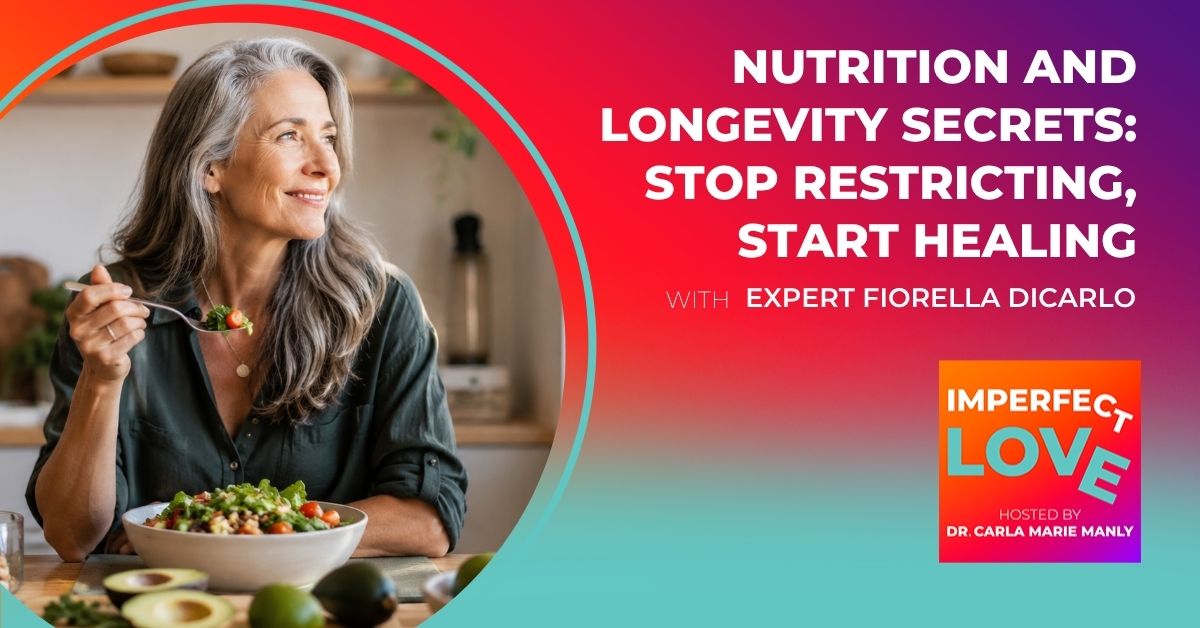
It can be challenging to stay fit and healthy. Yet it’s easy to fall into the trap of believing that one pill, diet, exercise or lifestyle hack will be the key to being in top form. And we’re hit daily with an array of ads that promise far more than they deliver. In many cases, from GLP-1s and supplements to diets, the downsides such as muscle loss and eating disorders are often cloaked or ignored. People seeking a magic bullet–or at least a dose of hope–often get trapped is costly cycles that may actually harm their health. Today’s top-notch expert, registered dietician Fiorella DiCarlo, will guide us through simple nutrition strategies you can take to optimize your hormones, fitness, and overall health–and get off the hamster wheel of harmful health fads. You’ll discover how to optimize your metabolic health and mood by adding nutrients, not subtracting food.
Topics discussed include nutrition, healthy eating, eating disorders, binge eating, anorexia, medical care, physicians, dieticians, GLP-1s, silent malnutrition, creatine, hormones, normative diet culture, disordered eating, research,
Please note that this episode contains sensitive material including the discussion of eating disorders; listener discretion is advised.
Emergency Assistance Details: If you or someone you know needs immediate support, please call your emergency services. In the US, 24/7 help is available by calling “911,” “988” (Suicide and Crisis Hotline), or SAMSA (Substance Abuse and Mental Health Services Administration) at 1-800-662-HELP (4357). As applicable, additional resources may be provided in the show notes.
Non-Emergency Online Mental Health Information: https://www.nami.org/support-education/nami-helpline/ and https://odphp.health.gov/myhealthfinder/healthy-living/mental-health-and-relationships
IMPORTANT DISCLAIMER: No expert is offering medical or psychological direction or advice; the content is purely informational in nature. Please consult your physician or healthcare provider before undertaking any new regimen or procedure.
Connect with Dr. Carla Manly:
Website: https://www.drcarlamanly.com
Instagram: https://www.instagram.com/drcarlamanly/
Twitter/X: https://www.twitter.com/drcarlamanly/
Facebook: https://www.facebook.com/drcarlamanly
LinkedIn: https://www.linkedin.com/in/carla-marie-manly-8682362b/
YouTube: https://www.youtube.com/@dr_carlamanly_imperfect_love
TikTok: https://www.tiktok.com/@dr_carla_manly
Books by Dr. Carla Manly:
Joy From Fear: Create the Life of Your Dreams by Making Fear Your Friend
Date Smart: Transform Your Relationships and Love Fearlessly
The Joy of Imperfect Love: The Art of Creating Healthy, Securely Attached Relationships
Imperfect Love Relationship & Oracle Card Deck by Dr. Carla Manly:
Connect with Fiorella DiCarlo:
Website: https://www.fiorellard.com/
Instagram: https://www.instagram.com/fiorellaeatstv/
Menopause Guide: https://www.fiorellard.com/menopause
GLP-1 Information: https://www.fiorellard.com/glp-1
Eating Disorder Support: https://www.nationaleatingdisorders.org/
—
Listen to the podcast here
Nutrition and Longevity Secrets: Stop Restricting, Start Healing
It can be challenging to stay fit and healthy. Yet it’s easy to fall into the trap of believing that one pill, one diet, exercise, or lifestyle hack will be the key to staying in top form. We’re hit daily with an array of advertisements promising far more than they can deliver. In many cases, from GLP-1s and supplements to diets, the downsides such as muscle loss, eating disorders and other health issues are often cloaked or ignored.
People seeking a magic bullet or at least looking for a dose of hope often get trapped in costly cycles that may harm their health. Our top-notch expert will guide us through simple nutrition strategies that you can take to optimize your hormones, fitness, and overall health and get off the hamster wheel of health fads.
In this episode, we’ll focus on this reader’s real life question. “My sister went on GLP-1s and she’s looking gaunt. She had an eating disorder in her early twenties and I’m worried she’s headed down a bad path. She thinks she looks amazing because she’s lost the weight she wanted to lose and she fits into size four clothing again. Do you have any suggestions for how I can talk to her or nudge her into eating healthy instead of eating like a bird? She doesn’t look well.” With that issue as the focus of our episode. I’m Dr. Carla Marie Manly, and this is Imperfect Love. Please note, as this episode contains sensitive information. Listener discretion is advised.

I am so excited to bring you a wonderful guest Fiorella DiCarlo. Fiorella is a top-notch expert in health issues. She’s also a Registered Dietitian. Welcome to the show, Fiorella. It’s such a joy to have you with us.
Thank you so much. I appreciate it. I’m excited.
Thank you for joining us. I know you have so much experience in this realm and so much great information to offer. Before we launch into this important topic, can you tell our readers just a little bit about what makes you, you?
Rebuilding Your Personal Relationship With Food
I was born in Italy. I was raised in New York and I am a registered Dietitian that specializes in the treatment of eating disorders. I love to bring in the love of food. I love to hear and learn about people’s relationship with their food. To me, that is one of the most important things to learn about oneself and other people. I grow along with my clients in doing so.
I love that introduction. Thank you. It tells me a lot about you. The relationship we have with food is so important to look at. We often don’t slow down. Some people live to eat. Others eat to live. Some people love food, but hate it at the same time. They battle with their food or comfort themselves with their food. We make food far more than nutrition, which is understandable. We live in a stressful world.
When you look at this question, which has many layers to it. I appreciate the individual who wrote in who’s concerned about the sister. To me, that is a great act of love. They want to be careful not to judge this individual. We all probably know someone who has gone on GLP-1s or has a disorder or both or lost a lot of weight on GLP-1s and they don’t look great.
On the other hand, I know people who are on GLP-1s and they look amazing because they’re doing all the right things. They’re exercising and building muscle mass at the same time. We’ll be able to look at a lot of topics. I also know you’re an expert in hormone health, particularly for women. It’d be fun to see how much of that we can weave in as well.
For sure. They’re all intertwined, so it’s interesting.
When we think about hormones, men and women. It’s not a gender thing. We all need hormones. We need them replenished as we age, but for women in particular. Men can take all of the hormones and get them easily. All the testosterone. Whatever they want, but for a woman to get the hormone replacement that she needs as she ages until very recently because of that very primitive and poorly designed and poorly interpreted study for the women’s health initiative, it was the women’s unhealth initiative from my perspective.
Now, that has been addressed. Women are now able, if their doctor is at least moderately competent. They are able to get the hormone replacement therapy that they deserve. I know this is not an assault on the medical profession. Maybe not the practitioners, but the big corporations that manage them and have tamped down on this unnecessary expense under the guise of saying that it was not good for women’s health. Men’s health as the issue, I am sure that black box warning, so to speak, on HRT for women would have been addressed, reanalyzed and removed a long time ago.
I agree with that as well.
There are so many women who have been negatively impacted and so many more who don’t have the resources or awareness to get the hormone replacement that they deserve and need because we are living so much longer. Before, when women were dying in their 30s and 40s from childbirth and infections and all this. Now women are living until their 60s, 70s, 80s, and 90s as well they should. We want women to be aging healthfully as we want men to be aging in healthful ways.
To the question, there’s a lot of parts to it. One of the most important things about the GLP-1s and eating disorders is that there isn’t a lot of screening yet. This is still uncharted territory in terms of how the GLP-1s are being prescribed. Not just for the intended population that it was originally to be prescribed for, but there are platforms everywhere now that are prescribing GLP-1s for people who want to lose 5 to 10 pounds that will be in their advertisements. Which was clearly away from the population it was initially intended for. That’s something right there.
The 5 to 10 pound, or 15 pound person, what is going on there? Is there an eating disorder in the mix? Do they have a history of anorexia? Do they have a history of binge eating disorders? There’s not a lot of screening in place here for the practitioners who are prescribing GLP-1s. Across the board, as someone who treats eating disorders, there’s so many. There are very few doctors who will specialize in eating disorders. Not to say anything negative about their practice in general, but not having that exposure even in medical school about it, what it looks like, what it sounds like, because eating disorders sound so much like normative diet culture at times, at least on the surface.
Building a healthy relationship with food starts by understanding your emotional connection to what you eat. Share on XIt does go under the wire a lot. In these prescribing the GLP-1s, there is no screening yet that is effective. I’m hoping it’s coming any day now. That one would be able to screen some patients in this area. To the question, if there is a history of an eating disorder, I truly believe that there should be an eating disorder specialist who is treating the person alongside their GLP-1 journey, just in case, because what we do know now is that GLP-1s do activate the same part of the brain that eating disorders are activated in.
Understanding GLP-1s and Eating Disorder Triggers
Under eating, it acts the brain in a certain way in the same way an anorexic would. GLP-1s generally don’t take people down from overeating to normal eating. It takes people from potentially overeating to below and under eating. That is where if the person is not eating properly on a GLP-1, that their brain can start to become activated in an eating disorder pattern.
Thank you for bringing that up. The other piece I remember, a long time ago when I was researching, anorexia in particular. It is one, if not the most deadly of the eating disorders and mental health disorders. With anorexia nervosa, you are starving your mind. You are starving your body. You are starving the muscles. You starve the muscles. One of your key muscles is your heart. Your heart can give way very easily.
As we look at GLP-1s, this is the part that gets particularly concerning for me, because your heart doesn’t know when it is being starved that you’re working on your biceps. Your biceps are looking good. You may be doing all the work so your glutes look good, or your hamstrings, but we don’t know short and long term, but particularly long term, what’s happening with your heart. We know that when we’re starved, the body starts eating muscle.
The heart is a muscle. The body doesn’t differentiate. It doesn’t say, “I’m not going to eat the heart because it’s keeping me alive.” It just says, “It’s muscle to eat.” I appreciate that the individual wrote in out of concern saying, “My sister’s looking gaunt and she has this underlying eating disorder.” That’s the other thing with many eating disorders. It’s just like alcoholism. For many people, they may go by the wayside for years. Sometimes a matter of even decades and they can be triggered again. Please talk about this more.
Managing Emotional Dysregulation and Anxiety Driven Eating
To start out the eating disorder idea. Mostly, eating disorders are coming from a place where it is coming out of anxiety. It is the way that the person is using to manage their anxiety and to be emotionally avoidant at the same time. Most eating disorders are an issue of emotional dysregulation. That is what leads to that type of attraction to food in terms of organizing it in such a way that allows the person to feel safer. That’s what they’re looking for. They’re looking for safety. I hear over and over with my clients, “I know I can’t control anything else, but this is what I can control.” By doing so, they feel that they get this sense of safety through that.
In fact, through the starvation and the starvation of the brain, the anxiety and depression, but mostly anxiety, is becoming activated even more. A starved body is going to be a more anxious body. The person is stuck in this loop of trying to remedy the anxiety from the starvation with more restriction. That’s where that cycle gets entangled. Now, on the body image aspect, what the person is looking for, and even though eating disorders are about food, but not about food, about weight, but not about weight. It’s more about their relationship to the food.
What happens is that there’s also this very cultural idea of this fantasy around what one will attain or feel once they reach a certain weight. That a lot of the time is what they’re striving for rather than just the aesthetic, but what they feel they’re going to feel when they get there. That is the thing that I love to work on the most because I like to ask that question of, “What do you think you’re going to feel? What do you think you’re going to have or not have anymore when you reach that ideal weight?”
When you start getting into that with a person, you can slowly start breaking away how their anxiety is attached to getting there.
Beautifully put. You’re taking us down the path of anorexia, binge purge, those eating disorders that are starving the body or fuel and starve. It’s important just to touch on it. The part where people also overeat for the same type of reason. As I say, it is about feeling safe. For the anorexics, it’s generally about, “I can control this part of my life. I can give myself five carrot sticks. I can do this. I can do that and I’m in control. Everything else in my life is out of control.” Whatever it’s. That’s how they feel.
Having this sense of control over these very tiny portions feels good or they may overexercise. All of those little things that help them control that tiny part of their life, or maybe a large part. In the same way, somebody who is overeating, it can also be from this sense of, “The world feels scary. It feels out of control. I can’t control how people treat me, look at me, or any of these things.” Instead of being able to address that on a mental health level, they eat then, which is understandable. They end up eating more and more.
They judge themselves more as they get heavier, the society, people, which is very shameful, end up shaming them, so then they need to get more comfort. They tend to retract and feel lower about themselves and their self-esteem. We get into these cycles and then if they have the wherewithal, the financial means, then they say, “I’ll try this diet. I’ll try this fat,” and then often goes through the same cycle again. I can see why for many people who are in these cycles.
It sounds like a magic bullet. It’s just going to fix everything. It’s like, “I’ll be thinner.” Exactly what you were saying, the idea that my life will be better. Everybody will love me. My problems will melt away. When I fit into these clothes or have this body, everything’s going to be so much easier. That doesn’t happen. Your life may feel better in some ways, but it’s not a magic bullet. That’s one piece. The other piece is that underlying eating disorder. Unless you’re working, self-work, psychotherapy, or something, can just be there waiting, which is why so many people, as soon as they go off a GLP-1, bounce back to where they are.
That is multi-faceted, rebounding in the sense. If the issue is having the relationship with food not being there before the GLP-1, it will still be the same after the GLP-1. I like to say to people who I am working with now who are on a GLP-1 and do have a history of an eating issue. They were on the GLP-1 before they met me. I do try to work with to help them while they’re on it to make sure, like, “Are we making sure that you’re not eating way below your caloric intake?” That can activate the eating disorder to come up.
Anxiety often drives disordered eating patterns. Finding safety within yourself is key to breaking the cycle. Share on XAlso, under-eating, slows your metabolism. Part of the rebounding is coming on, eating normally and holding on to calories. It’s the same yo-yo diet effect that we’ve always known about. It is enabled in GLP-1s when someone’s coming off of the GLP-1. Also, I don’t find a lot of structured guidance, again, still new, about how to eat when you’re on the GLP-1, how to start to wean yourself off when you’ve reached a certain target weight, and then what happens afterwards? Lifestyle and so on.
It sometimes behaves like a restrict binge cycle, physiologically so and psychologically so. Hence, the rebounding of the weight. That’s where it gets so tricky. Many people are becoming disappointed and feeling frantic about going right back on again. They’re so frightened to come off of it for fear of weight gain again. I hear a lot of reports from my colleagues who are telling me that it’s almost feeling a little addictive type attraction to it. It’s like, “I need to take another shot before I go to the beach,” because of the fear of the weight gain that’s going to come. The fear that if they don’t, they will lose control. You’ll hear a lot of the same verbiage that is coming from my eating disorder and from GLP-1 clients as they’re going through the process.
That makes perfect sense. Again, we come back to the part about life. It’s normal to crave a magic bullet. They’re all around us. We’re told, “This pill. That pill. Buy this ice cream and you’ll look 100 years younger or whatever it is.” We are sold all of these every day, often. Depending on how much you’re on social media and any site where you’re getting news or searching for something. Something’s going to pop up.
We are programmed to believe that this is out there. I can say as a human being, when I’m searching for something and something pops up. I’m like, “That thing magically erases every single wrinkle. That’d be cool.” Then I go, “Your wrinkles are fine. It’s fine. Whatever it might be.” When we look at this beautiful thing called our body, and I appreciate how you are saying, “Underneath all of this is the mental health issue that is going to be there,” if it is indeed a mental health issue.
All people who go on GLP-1s don’t have mental health issues. When we address the root problem of, “I’ve learned to overeat.” Have you learned to overeat? If you’ve learned to overeat, as you were saying, when you go off the GLP-1, you’ve learned to rely on the GLP-1 to halt your caloric intake. You haven’t learned to rely on yourself to say, “I’m full.” I’m half Italian, and as my dad used when he was done, “Basta.”
That was his cue, and he spoke it aloud all the time. Now as an adult, I realize he was signaling to himself, “I’m full.” He was a trim man and he was just registering, “My body’s full. Basta.” When we see that we can learn, I’m not demonizing GLP-1s or anything. That’s the piece that our medical system fails on. It’s like if somebody is going for bariatric surgery. They’re generally required, which I am a huge fan of. If everything else hasn’t worked and bariatric surgery works for you, go for it.
Do the psychological work so that you get used to having smaller portions, that you’re not battling it. You’re not having the psychological issues that are underneath. Often, those come from childhood issues where we were shamed about eating or forced to eat too much or sometimes forced to eat too little or our parents were fighting so we went to food for comfort. Whatever it is. We want to address those habits so that as we get help getting fit, that if we choose to go off GLP-1s or whatever it is that we’re doing. We have a healthy pathway forward that is sustainable. That’s what we’re looking for.
Exactly. It’s so interesting too for GLP-1s that are getting prescribed. I will hear from a lot of psychiatrists that will say, “They’re good for people with binge eating disorder.” Interestingly, what I’ve found out with my clients is binge eating, because GLP-1 works on our early satiety and by decreasing our motility. It slows motility. It increases our fullness cue more quickly than on average.
My bingers feel their fullness cue as well, but continue to eat despite that because what they’re trying to achieve has nothing to do with fullness at that moment. They’re trying to achieve feeling something or not feeling something. When they are on the GLP-1, at least for the first couple of weeks or the first couple of months, they might still be pushing past and getting very frustrated that the GLP-1 is not working for them. I find that interesting too about fullness cues and satiety.
Thank you, because you see so much more of this than I do in my practice because I’m not a Nutritionist. I’ve been around people who are on GLP-1s. Sometimes, you can’t help. I’m not trying to inspect them or use them as specimens, but you can’t help notice that sometimes they’re not eating in very healthful ways. People who are consuming a lot of sweets more than they did before, almost like they’re psychologically giving themselves permission. Is that what you see?
It is exactly that because remember, taking the opportunity to truly choose food to get something emotional out of. Why would I waste my time on, let’s say, a protein forward diet if I can feel what I need to feel off of or avoid whatever I need to avoid by eating this item? That is what you’re seeing, and there is a bit of permission. I hear it all the time, “I feel permission because I have someone or a safety net to take care of the ramifications.”
I realize that this also occurs with people who are using insulin. Where they can dose so that they can have a slice of chocolate or two slices of chocolate cake. We’re looking at somehow enabling eating disorders because then the brain says, “This is great. I can eat these things and get away with it,” and that’s true. Yet your poor body is now being deprived of the good clean fiber and the good solid protein. Having not always had the greatest eating habits in my life, I am now especially fascinated by how our bodies are pretty simple. They like us to keep it simple. Let’s keep it simple. Let’s keep it clean.
It’s not a good pyramid that many of us were raised on with all carbs at the bottom and vegetables, a little bit of protein. It wants us to avoid sugar as much as we can. Unless it’s coming through fruit, avoid the sugar. Have some good, strong, healthy protein intake. Have your fruits and veggies and some carbs. It’s fine. Nothing is forbidden, but it is about finding that right balance. We often don’t do that when we think we have a magic bullet. I’m so glad that it resonated with you because it’s what I was seeing that permission factor. It’s like, “Now I can do this because the GLP-1 will take care of it or the insulin will take care of it.” Suddenly, the body ends up paying the price.
Preventing Silent Malnutrition on Weight Loss Medications
That’s right. A lot of the studies now around the GLP-1, that GLP-1 can, if one is not careful, cause literal malnutrition. They were picking up on scurvy. The early satiety and the side effects like nausea and gastrointestinal side effects create these food aversions. It’s almost like pregnancy in the sense that the first thing that we psychologically get averted to is proteins.

We prefer to move towards comfort foods, which ends up being carbohydrates anyway. At least in the preliminary stages. That’s one of the reasons for the low intake of protein, as well as anything that’s reduced in calories by default. The proportions of the macros go down too. That’s important. You will see the body as you’re watching everyone shrink before our very eyes and going too far.
It’s very similar to why someone with anorexia. There is a point where body dysmorphia doesn’t allow them to see themselves the way we do. Someone walking around looking emaciated doesn’t quite see themselves that way. Hence, why they continue on this quest to go further. We’re picking up a little bit on this with GLP-1s as one becomes more and more malnourished.
Thank you. It takes us back to the reader’s question, which is the idea that when we see someone we love, whether it’s a sibling or a good friend. It seems obvious that they’re on GLP-1s or something because all of a sudden their body is changing overnight. We might look with great concern at them, but we don’t want to say anything for fear of hurting their feelings or making them feel unsupported or angry.
Trying to be good people, good friends and siblings, we’d say, “You look great,” and that’s a common tendency. I remember I saw someone who I hadn’t seen in a bit, and they had gone on GLP-1s. I didn’t realize they were on GLP-1s. I said, “Are you okay?” I thought they might have cancer from the way they looked. They love the way they look. They are happy with how they look.
Nothing I would say is going to change that. You, by default or I should say I, by default support them and love them unconditionally. On the other level, you’re worrying a bit, as this reader is talking about. For her, she has even a bigger investment because it sounds like she truly loves this sister. Before we go to the hormone piece, let’s take to how might you advise this individual who wrote in to say something to her sister that’s not going to be off putting? That is a pretty sensitive issue.
Navigating Sensitive Conversations About Disordered Eating
Especially for anyone having a past with an eating disorder, the verbiage is so important. Much so when I was working in an eating disorder inpatient with clients. We were not even allowed to say, “That’s a lovely dress.” Any commentary about appearance could have been taken in a different way by the person, saying, “What are you trying to say?” Even when you say, “You look so healthy.” Healthy meant fat in the way that it was being perceived.
It is a challenge for your reader, but I would gently err on the side of just saying to the sister, “You do have a history of an eating issue, and so much of our relationship with food can be activated when we begin to lose weight. I just want to make sure that you’re doing it in the healthiest way. I want your brain to be at peace.
I want you to reduced anxiety about food and body. I want to make sure that you’re taking all of the precautions around this.” Sometimes, it is important to say rather than not say, because many of my clients will say, “No one said anything to me.” I knew that I was going far and everyone around me acted like it was normal then they felt betrayed in that way. Delivery is everything.
Thank you, that it can feel like a real double-edged sword. That if you say something, you may make them angry. If you don’t say something, then what happens if they pass out in a parking lot because they are on their way out because their heart gave way? I agree with you 100% if it is well said. I think of people I’ve lost where I wish I might have been a little more proactive. Not that I would have changed the outcome.
I can’t change the outcome but I can be a little more direct with people and say, “I am concerned about this because of this. I’m here to support you. If nothing else, I can offer you good resources.” I can see that it’s possible for the individual who wrote in or to any reader who’s concerned about somebody to take them aside in a quiet place. When they’re not stressed, the old HALT thing, not when they’re hungry, angry, lonely, tired or stressed.
I add an S to the end of HALT because we have to watch out for the stress piece and say, “I want you to know you do look terrific, because you’re radiating that you’re happy. I want you to know that I am a little concerned as your sis or your friend. You look like you might be getting toward the very underweight territory. I’m not judging you or blaming you, or certainly shaming you, but I’m letting that I’m here as a resource to help you find maybe a good psychologist who can support you just to make sure you’re getting the mental health care you need or a nutritionist.”
We forget the power of a solid nutritionist who’s not going to judge us. If they’re well trained, as you’re, there’s no judgment. It’s like, “Let’s take a look at your diet. Let’s see what you’re taking in.” I wish that I had learned about nutritionists early in life. This is my personal thing about nutritionists. They can help you realize that it’s not calorie in and calorie out.
If I ate three donuts, I might have my day’s worth of calories, but I’m certainly going to deprive myself of an incredible host of nutrients, of vitamins and minerals that my body does need. Taking a vitamin tablet alongside my three donuts isn’t going to do the trick. We want to realize that in talking to someone that we love in a quiet place with graciousness, respect, and empathy, and no top down, “I’m better than you energy.” That’s not going to go anywhere.
I’m thinking about this listener, also maybe even saying something like, “If it’s okay with you, I’d like to check in again on how things are going in 3 or 6 months.” It doesn’t mean you can’t try it again or maybe what you said is enough to make them think, “I do deserve some psychological support here or I do deserve a nutritionist.”
When discussing disordered eating with a loved one, focus on emotional well-being rather than appearance. Share on XIt’s so interesting, Fiorella. We expect ourselves to know healthy nutrition. I expected myself to know healthy nutrition. Once we start learning it at whatever age we learn it, it’s like, “I can make simple shifts that are going to make me feel better. My body will run better. I feel more energetic.” That’s something we learn. We are not taught this or if we are taught it, we’re in a place in life like grade school or junior high school where it’s in one ear and out the other because there’s a cute boy or cute girl or something going on.
Tuning Into Physical Hunger and Satiety Cues
It’s so interesting because I find from the beginning, one of the things that I say to all my clients to start with. They say, “What do you think of my food? What would you change here?” The very first thing I do before I even go into the meals and all of that is, are you eating with your physical hunger mostly? Are you aware of your physical hunger cue? Are you connected to your body? Are you aware of your fullness cues? How does that feel?
Most caloric intake that is taken in excess overall, just broadly speaking, is coming from eating outside of hunger frequently. I say that frequently. I underline the word frequently because I want to say on occasion we do. It’s not a big deal to eat outside of hunger just because something was just lovely and you wanted to taste it. That’s great. Someone who is eating outside of their physical hunger frequently, and it’s usually through a mechanism of self-soothing. That is the first place I go, first and foremost. A lot of the time, you can create a deficit just by managing that before you even get to the food.
That’s why I always err on the side of caution when we were talking about the quick pill and quick fix and quick product. It never is just one thing. You are not outside of your homeostatic weight because you had pizza for lunch. That is not the reason. It’s your overall total relationship with food throughout the day that is the culprit. You could have some yummy nutrient dense foods too.
I appreciate that you brought that up, Fiorella, because what I find with so many people is that they have one or two times in the day, often at night. When they’ve worked so hard and they say, “Now, I get my reward for a day of hard investment.” That reward doesn’t come in necessarily some way that’s healthy. It comes in sitting down, watching something on TV or Netflix or YouTube. Whatever it is. Coupled with five slices of pizza, a bowl of potato chips.
Instead of giving themselves the gift, because if we learn to see a healthy meal as a gift, then it’s like, “I’m going to give myself this beautifully balanced meal,” and maybe a snack afterward. It’s realizing a lot of it is about non judgmentally evaluating our habits. Sometimes, I know that when people are talking to a dietitian or even to me, they’ll say later on, “I didn’t tell you the whole truth about my nutritional picture because I was embarrassed.”
You and I have probably seen everything there is to see, whether it’s in our personal lives or our professional lives. It’s like, “I’m not going to judge you.” If you tell me all you ate all day was donuts and cupcakes, I’m not going to judge you. I’m just going to figure out why donuts and cupcakes. Why? What in your childhood, what in your adulthood is, and can we not cut out all donuts and cupcakes? How about if we just trade a couple of them at first for something that might have a little more for your brain and your body? Please let me know what you think of this.
It slowly makes these adjustments. Research does prove this out even in childhood. That once we start giving ourselves permission to have a little bit of sweets but focus on trying to get the bulk, the body finds its way. The palate changes to not want only cupcakes and donuts. It could be pizza, or whatever it is. Fill in the blank, whatever your thing is.
It’s not about judging. If you have a good clinician, a good dietitian, or a good medical doctor, they’re not going to judge you. They’ve seen, I’ve seen, and you’ve seen almost everything. It’s about, “Let’s talk about this. Let’s figure it out.” We’re puzzles. We humans are puzzles and we do some very interesting things.
When we learn to look at the puzzle and put it together with kindness, compassion, self-love, other love. We can do good things for ourselves and those in our lives, but we have to be open to putting, to looking at that puzzle, popping it out of the box. We’ve got to get it out of the box before we can start looking at it. Before we run out of time. Let’s move into a little bit on hormones, whether looking at men or women, but maybe a greater focus on women, please. Thank you.
What you said in the beginning of the session, is that HRT for women. That study set some things back for certain women who could have gotten it. It’s heartbreaking. Even now, when we have this menopause revolution going on that I’m so happy about, and hearing Melinda Gates giving all the money for that. I was like, “We’re getting some support here,” and some documentaries that are coming out around menopause. Still, women are going to their doctors and feeling that their symptoms are being minimized.
I have heard so many clients going to doctors saying, “I’m feeling really depressed or I’m feeling this way or that way.” They’re like, “You don’t look depressed.” Those types of answers. It’s so important, because most women themselves have not received an education about what menopause is and how it feels like. They didn’t discuss it as much. At least in my parents’ generation, more like but now, there’s an education that feels like is much needed.
Women need to understand that there’s a certain place that they’re where the hormonal changes have a huge impact on their health, and that’s mental health, physical, heart health, and cognition. All of these sorts of things is a total body change and women should not be suffering on it alone. Nutrition does become a big part of this. The most important thing is the idea of regular eating. A lot of people begin with some weight gain, if they experience some weight gain and not regular eating. Building meals around protein is an amazing start.
Focusing on nutrients such as omega-3, fatty acids, vitamin D, and iron helps address a lot of the deficiencies that are coming up at this time that estrogen brings on. Looking at it from a whole lifestyle, holistic way and understanding what is going on with the person, even psychologically because if someone is feeling more depressed, they’re so much less apt to do some weight training for their muscles or take a walk. Most women don’t even understand what’s going on with them. I would love to provide that for my clients to just break things down for them. What is your life like holistically? How are you feeling? What are your side effects? How’s your gut health? I like to look at it all together.
Boosting protein intake and using creatine can strengthen muscle health and mental clarity as you age. Share on XThank you. Again, that’s a piece where our medical system fails us and I can speak on a personal level. I asked my OB-GYN for labs so I could evaluate my hormones. She said, “We don’t do labs for hormones. We only do hormones if they’re needed based on how you feel.” I went to my primary care physician and I asked, “Can you order a lab so I can see where my hormones are?” They’re like, “We don’t order labs for hormones. That’s not something we do here.” By the way, and I will say this out loud, I have Kaiser medical insurance. I am not a fan. They do a lot of medical gaslighting. It is the worst healthcare system I have ever encountered.
What they do is take advantage of people because they’re taking your money in the form of premiums. They’re not giving adequate care. They do a lot of medical gaslighting. For the very few people who have the energy, as I do, to self-advocate. They send you into this hell of paperwork with the California Board of Insurance. Systems like this, not just Kaiser, are rampant across the country and throughout the US. Who suffers?
Not the mega wealthy people who can afford a concierge doctor and bottomless medical expenses but your average individual and individuals who have perhaps no insurance at all or can barely make a copay. What are they going to do? If they don’t have the awareness or the education like I do, I’m talking to people all the time, so my education and awareness keeps increasing. It’s so infuriating.
That’s one of the reasons I love being able to put podcasts out there is to help people know, “You’re not alone. If you’re getting frustrated by your healthcare system, your frustration is probably very on point if you’re being gaslit. I’ve had medical doctors on the show who have said they know there’s so much medical gaslighting going on that’s why maybe they left this system or that system. We can all become part of this necessary change by being voices, by talking as you do such a wonderful job.
You do a great job talking as an advocate and a source of information. Podcasts are free. They are free. By listening to a podcast, you may learn something or be able to take something to your physician and say, “Show me the research on this. I heard about this on a podcast. You’re denying this. Show me the research,” and they often don’t have the research. Maybe they’ll give you research from 50 years ago, and say, “This is what the American Medical Association says.” The AMA is not good..
That is much needed.
Women’s wellness, men’s wellness, whatever gender you are, you deserve to be healthy. You deserve to be well. That’s what Fiorella is helping to do in a wonderful way. You make it simple. You don’t make it overly complex and you’re talking about food as a form. Looking at your relationship with food as a way to maybe address underlying mental health issues. Maybe you’re looking at stress. Maybe an eating disorder. Maybe you don’t know how to self soothe.
Maybe you just go to food because it’s the one place in life where you get some sense of comfort and control. That’s all normal, if not healthy for you. Last piece on the hormones. For someone who is perimenopausal or postmenopausal, what would you say if they could do one thing for themselves nutritionally?
Optimizing Hormones with Protein and Creatine Supplementation
I’m going to give you a little two parter. I would say increase your protein for sure. The women under eat it anyway and have the most need for it. Secondly, I like this idea of creatine.
Say more. I know very little about creatine.
Creatine is naturally made in the body but sometimes, depending on life environment, our eating habits and so forth, we don’t get enough of it. Particularly in perimenopause and menopause. Being able to get this creatine to replenish our muscle stores, including our brain. There’s a lot of studies, not just muscles all over our body, but brain as well.
It helps with cognition as well in perimenopause. It infuses the muscles to be able to rehydrate and behave in their optimization. Taking about like three grams per day for about a month so that you’re fully infused with it and then you can take it here or there or maybe in a shake or in some water, helps with that. It’s shown in a lot of studies to help muscle repair. Muscle regeneration and cognition. It was more of like a like a gym guy thing to do.
That’s what I know it from. That’s why I was looking a little askance.
Same. This is a newly research that I’ve dived into as well. I’m like, “That’s interesting. Let me look at this a little bit more.”
Is it in a powder form?
It is in a powder form. There are some pills and gummies available for that, but it’s more bioavailable in the powder form. You have to also be very hydrated as well. That would be my recommendation. It hydrates the cells, but also potentially appears for a little while for a month or two, as if there’s some water attachment to it, so some water weight. Don’t get nervous.

You’re just getting a little plumped up as your body adjusts.
Exactly. It’s from a lot of the studies around it and a lot of people are recommending it for this thing. It has almost no side effects whatsoever. It’s a nice start. That and protein.
Neither one of us bring any medical advice. We want you to talk to your provider. If you can get three seconds with them to make sure that anything you are going to do, that you talk to them, and see a blood workup. I love seeing before and after results. If you can get a blood workup before you start, a new protocol and then a blood workup three months down the line so that you can see what’s working and not working.
If things are working, lean into it. If something’s not working or it’s not feeling good to your body, then don’t. You’ll find your way one step at a time if, as you say, Fiorella, you learn to listen to your body. That is the key. Learning when you’re full and how the body signals us. We don’t tend to realize we’re full when we really are full because it signals us after we’re full by about a lag of 30 minutes.
Sometimes if you get up during a meal and just take a break for a few minutes. Maybe carry your dishes to the sink. Maybe get a cup of water, then you realize, “I don’t want that second or third helping. I’m looking at.” Lots of little strategies. Fiorella, you are amazing and we have a wonderful way about you. Thank you so much.
You’re amazing. Thank you for all the great work you do for all of us. That’s wonderful. I appreciate it.
I was a bit fiery because I get fiery talking about women’s health and how people in general are underserved.
It’s fantastic.
It’s ridiculous. Where can our readers find you?
You can find me on my website. There’s a lot of things there that you might find interesting in terms of studies and so forth. I developed the GLP-1 Stability System for Nutrition with a little bit of a screening for eating disorders too. That’s very interesting. It’s at FiorellaRD.com. You can just follow me as well on social media at @FiorellaEatsTV.
There you have it. Again, Fiorella, thank you so much for being with us. It’s such a treat.
Thank you so much. I appreciate it. I have so much fun.
Thank you. I did, too. To our readers, thank you as always for joining us. It is such a joy, a pleasure and a privilege to share time with you and help support physical and mental wellbeing. This is Imperfect Love.
Important Links
- Fiorella DiCarlo
- Fiorella DiCarlo on Instagram
- Fiorella DiCarlo on YouTube
- Fiorella DiCarlo on X
- Fiorella DiCarlo on Facebook
- Menopause changed your body
- On a GLP-1, tapering, or done
- Creatine supplementation with specific view to exercise/sports performance: an update
- Mapping the effectiveness and risks of GLP-1 receptor agonists
- Get Help For Eating Disorders
- National Eating Disorders
- NAMI HelpLine
- Mental Health and Relationships
About Fiorella DiCarlo
 Fiorella DiCarlo, RD, CDN, is an Italian-born Registered Dietitian, on-camera food correspondent, and published author based in South Florida. She is the creator of FiorellaEatsTV and host of Living in Italian, with featured appearances on NY1 News, South Florida Live, and PBS All Health Go, as well as quotes in Forbes, Women’s Health, and Atlantic Magazine. Fiorella is also the developer of the GLP-1 Stability System™, a proprietary nutrition approach for individuals using GLP-1 medications, and is available for media appearances, nutrition segments, brand collaborations, and expert commentary.
With more than a decade of experience, Fiorella specializes in eating disorders, prenatal and fertility nutrition, weight management, medical nutrition therapy, and family nutrition. Her work blends nutritional science with therapeutic insight to help clients build healthier, more sustainable relationships with food. She holds a Bachelor of Science in Nutrition and Food Science, along with advanced postgraduate training in eating disorders treatment from the Women’s Therapy Centre Institute and the William Alanson White Institute of Psychiatry, Psychoanalysis, & Psychology.