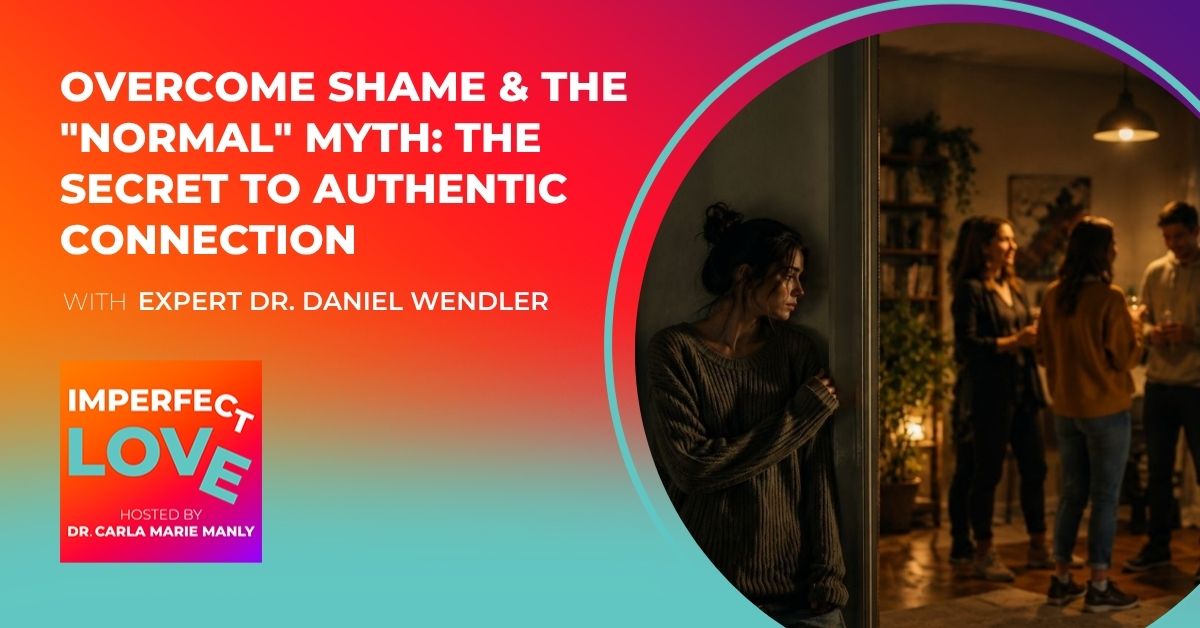
Do you hide quirky parts of yourself for fear that others won’t like or accept you? Are you afraid that others would reject you if you revealed your so-called “not normal” parts? I’ve found that many people sacrifice aspects of their authentic being in the quest to be accepted and fit in. Yet whether you are neurotypical or not, I’ve discovered that letting go of the myth of normality–and releasing the expectation that you need to be someone you’re not to fit in–can help you release shame, find fulfilling community, and build the solid, meaningful friendships you deserve. So today, we’re joined by Dr. Daniel Wendler, a leading psychologist, best-selling author, and TedX speaker who will guide you into the realm of self-acceptance and self-love.
Please note that this episode may contain sensitive material; listener discretion is advised.
Emergency Assistance Note: If you or someone you know needs immediate support, please call your emergency services. In the US, 24/7 help is available by calling “911” or “988” (Suicide and Crisis Hotline). Support/informational links are in the show notes.
IMPORTANT DISCLAIMER: No expert in this (or any episode) is offering medical or psychological direction; the content is purely informational in nature. Please consult your physician or healthcare provider before undertaking any new regimen or procedure.
https://www.nami.org/support-education/nami-helpline/
Connect with Dr. Carla Manly:
Website: https://www.drcarlamanly.com
Instagram: https://www.instagram.com/drcarlamanly/
Twitter/X: https://www.twitter.com/drcarlamanly/
Facebook: https://www.facebook.com/drcarlamanly
LinkedIn: https://www.linkedin.com/in/carla-marie-manly-8682362b/
YouTube: https://www.youtube.com/@dr_carlamanly_imperfect_love
TikTok: https://www.tiktok.com/@dr_carla_manly
Books by Dr. Carla Manly:
Joy From Fear: Create the Life of Your Dreams by Making Fear Your Friend
Date Smart: Transform Your Relationships and Love Fearlessly
The Joy of Imperfect Love: The Art of Creating Healthy, Securely Attached Relationships
Imperfect Love Relationship & Oracle Card Deck by Dr. Carla Manly:
Connect with Dr. Daniel Wendler:
Website: https://www.danielwendler.com/
Autistic Psychologist: http://heydrdan.com/
Instagram: https://www.instagram.com/drdanpsychologist/
YouTube: https://www.youtube.com/@AutisticPsychologist
TikTok: https://www.tiktok.com/@autisticpsychologist
Writing: https://writing.danielwendler.com/
Audiobook: https://www.audible.com/pd/Neurodiversity-and-the-Myth-of-Normal-Audiobook/B0CVBKYHQD
ADDA: https://add.org/
—
Listen to the podcast here
Overcome Shame & The “Normal” Myth: The Secret to Authentic Connection
Do you hide quirky parts of yourself for fear that others won’t like or accept you? Are you afraid that other people would reject you if you revealed your so-called not normal parts? I’ve found that many people sacrifice aspects of their authentic being in the quest to be accepted and fit in. Yet, whether you are neurotypical or not, I’ve discovered that letting go of the myth of normality and releasing the expectation that you need to be someone you’re not just to fit in can help you release shame, find a fulfilling community, and build the solid, meaningful friendships you deserve.
We’re joined by a leading psychologist, bestselling author and TEDx speaker who will guide you into the realm of self-acceptance and self-love. In this episode, we’ll focus on this reader’s real-life question. “I feel isolated at work because I don’t fit into the click. I moved across the country for my job and left the comfort of my family and few friends behind. I’m an introvert and on the spectrum, so things that are easy for other people are difficult for me. I can’t afford therapy, so please give me some tips.” With that issue as the focus of our episode. I’m Dr. Carla Manly, and this is Imperfect Love.

I’m delighted to be joined by an amazing psychologist, bestselling author, TEDx speaker, and wonderful human being, Dr. Daniel Wendler. Dr. Wendler, welcome to the show. It’s such a delight to have you with us.
Dr. Carla, it’s a true pleasure and an honor to be here.
Thank you for joining us. I love this question and sense it’s right up your alley. Before we dive into this special and poignant topic, could you tell our readers just a little bit about what makes you, you?
The best way to answer that question is to think about my closest relationships. I’m a big believer that we are shaped by the love that we have in our life. To tell the story of Daniel, it’s to tell the story of how my parents and my sister loved me as I was growing up. How my best friend, my wife, and my community of friends loves me and supports me. The ways that I find myself in those relationships. I get a sense of my strength when I support somebody. I get a sense of my tenderness when I open up to somebody. I get a sense of my humor when I’m playful with somebody that I care for. What makes me, me is all of the people that invite me to be myself with them.
That is so beautiful. I love the whole picture that you painted with your words. Particularly the part where you said, “The strength when you’re there to support someone and the tenderness in yourself when you open up.” I love that phrasing. That’s a big part of the dance of being human, isn’t it? It’s being able to be strong for the self and others. Also, being able to be tender, which requires that true vulnerability. Thank you for that lovely opening.
As an author, I want to say that the book that you have co-authored, the audio book, I appreciate how you’re addressing the myth of normality. When you do that and open that door, even people who aren’t on the spectrum, who don’t identify as being autistic or on the spectrum or in any way, it still resonates with all of us. I believe our quest to be normal or super normal or beyond normal keeps us stuck.
First off, I don’t know anybody who’s truly normal. Normal is a bit if there’s such a thing as boring, perhaps it’s that. Helping people find their authentic selves find tools to live in ways that make them feel strong and capable, but not hiding the parts that make them special and an individual. I’m excited for this conversation. It applies to most of us living on this planet.
I appreciate you saying that. I’m autistic myself. Early on in my journey I was like, “I want to help other autistic people who have struggled with some of the same things that I’ve struggled with fitting in, belonging, feeling this pressure to be normal.” As I grew into the field of psychology, as I started working with people, as I started putting my work more out into the world, I was like, “These are just human struggles.”
Releasing the Myth of Normality
People on the spectrum might experience them differently, but about everybody has felt a sense of, “I’m not normal. I don’t fit in. I don’t belong,” and carry that shame of it. That’s why I love being able to speak to this universal thing that is particularly relevant for neurodivergent folks. Everybody needs to hear that, like, normal is a myth. It is not a requirement. The ways that you are different from the norm are a good part of who you are. Not something that you have to apologize for or hide.
Thank you for starting us off in this way because you got to one of my favorite but most difficult topics for most people. It’s looking at that shame that comes with so many people I work with, whether it’s individuals or groups. They carry shame because they were told early on, whether it was by parents, caregivers, siblings, kids at school, bullies, teachers, or whatever it is, “Why can’t you just be less of this? Why can’t you be more of this? Why can’t you fit in? Why do you have to be so big? Why do you have to be so small? Why do you have to be so quiet? Why do you have to be so loud?”
We get all these messages and it’s so tiring to try and be everything to everyone because everybody’s going to want something different from you if you’re trying to conform and please. It also dims that light within you that just wants to be you. Your very best, most, shining, ever evolving you. To get to that shame that is underneath that, can feel like a shameful process, getting to the shame and acknowledging the shame.
A lot of people don’t want to acknowledge the shame, but that’s one of the first steps in the process. I can only think of this person. I’m going to turn it over to you in just a sec, but I’m thinking of the individual who wrote in and this sense of, “I’ve left a few people. I’ve left my family. Now, I’m on the other side of the country. I did this for my job. I don’t fit in. There’s a click at work.” I could imagine that they might feel hopeless. Possibly ashamed, angry, or disappointed. All of those things. I’m going to just give that to you because I’ve put a lot right at your door.
I appreciate you bringing up the shame piece because I truly do think that’s probably the heart of what this person who wrote in is experiencing and probably a lot of other people struggling with that. It certainly resonates with my own experience. I remember it maps almost perfectly onto what happened when I went to Oregon for grad school. The same thing, I left behind my family, and left behind my friends. I went into this new environment. It felt like the other grad students were a clique. I felt like I completely didn’t belong.
On my first birthday in grad school, I had a pizza alone in my room. That was my birthday party because I thought that if I tried to throw a real party and invite people, nobody would come. That was the shame speaking. That was saying that I wasn’t worth people showing up. I wasn’t the person that somebody would like. Speaking to that shame is critical because the more that shame takes root, the more that it robs your strength of doing the things that would allow you to go out and realize that the shame is false.
Normal is a myth. Releasing the pressure to fit in lets you drop shame and build authentic relationships. Share on XRealize that there’s people out there who would love you and appreciate you for who you are. That’s what ultimately pulled me out of it by making a single friend. It’s the guy who ended up being my best friend. He was my co-author on Neurodiversity and the Myth of Normal. He noticed that I was drifting through the classes and not connecting. He reached out to me and then we were able to form a friendship from that. My shame that the whole time had been like, “Nobody would ever like you.” I was wrong the entire time. He told me later he was intimidated by me.
He was like, “This Daniel guy, he’s smart. He seems like he has things together. I don’t think he’d want to be friends with me.” He was dealing with his own shame, but we had to get past that to form the connection. There’s certainly reality to the idea that not everybody on the planet is going to want to be your friend. The right people will want to connect with you.
I use the metaphor of, if you’re the best sushi restaurant in your city, not everybody’s going to want to eat there. Even though your sushi is good, because not everybody wants sushi. Some people are going to want burgers and that’s okay. For the right person, there is no better meal than what your sushi restaurant can provide. The same thing is true. For the people that love me, they want me. They don’t want some other version of me. For the people that are lonely reading this, there’s somebody that wants you. You just got to find them.
Thank you for the beautiful metaphor of the sushi restaurant, because when we love and know ourselves and don’t try to be a supermarket that’s ever changing. In the supermarket, you have all sorts of stuff on the shelves and people get lost in it. You can find it, but you don’t want to sit down and eat there. It’s not an intimate place where you want to sit and enjoy. Most stores, like grocery stores, don’t specialize in one thing. As human beings, we may have a lot of things to offer, but those things we want to be authentic with them.
To be that best sushi restaurant, that best burger bar, the best frozen yogurt place, or whatever, and learn that it’s okay. Even beyond okay. It’s one of our most important callings in life because when we get sure of who we are and work with our strengths, work with our frailties and let our light shine in that way. It doesn’t mean days are always going to be bright and sparkly, but it does mean we are authentic. When we are authentic, we let other people around us have their authenticity because we’re not trying to get them to change or shift.
That’s an important piece of what we’re talking about if you’re trying to break into a click into the sushi restaurant when you’re into Mexican food. As you said, often people on the other side are thinking, “I’d like to know that person, but they’re too smart or they’re too this or they’re too that.” The truth is, I don’t think we want everybody.
I know there are people out there who are perfectly wonderful people, but they’re not the style of person that I would want as my intimate friend just because their values might be very different. Their way of showing up may be very different. If we learn that we have the right to have a few select friends. It’s better to have a few select friends that we have chosen rather than welcoming anyone and everything into our life just so that we can say, “I have friends.” What do you think of that piece?
My mom used to use this example of everybody having a note that they play. With music, some notes are going to sound good together and are going to make a song, and some notes are not. That doesn’t mean that one note is bad or whatever. It means that it’s not the right note to go together in harmony. The goal is, you don’t make music by slamming every key on the piano at the same time. You find the right notes that work together.
The same thing is true. If somebody’s not right for you, it doesn’t mean that they’re bad. It doesn’t mean that you’re bad. It means that you guys don’t make the right harmony together. You want to find somebody that does. Also, you don’t want to try to make a fake version of yourself just to fit with them because you’re never going to be as good at that as somebody who’s naturally that way. It’s not going to be satisfying if you make a fake version of yourself to earn acceptance or to find the relationship. The love is going to that fake version of yourself. It’s not going to you.
It’s not going to fill that need that you have for intimacy and acceptance. That’s why it’s so critical. It’s hard. If you’re lonely, you’re sometimes like a drowning person looking for the first stable thing to grab a hold of but it’s so critical to be like, “I want to find somebody who can love me for me and somebody that I have a good crush on. Not somebody that I have to fake. Not somebody that is just not right for me.”
Thank you for saying that. I love your mom’s imagery as well. How true that is that, as you said, we don’t play music by slamming down all the chords. It’s about finding that right fit. The harmony, so to speak. A lot of it starts with knowing your authentic self because if you don’t, then you’re playing with somebody whose key does not harmonize or the way they’re playing is not a good fit or may never be a good fit.
It’s knowing yourself, your values, your needs, and your priorities. I believe that once we do some of that, not that the work is ever done, but then we do start becoming more magnetic for like-minded people. We’re automatically doing things that we like to do. We might run into people in those venues doing things they like to do. It’s so interesting that your experience with doctoral school was almost the opposite of my experience.
I was unsettled. It was new and everything, but I went from a place of looking at people in my life who no longer matched with me because I was growing and changing so much. When I set foot on campus for the second time, I went first to audit the campus. The first time I saw home, I was just like, “This is so wonderful.” The second time I went when I met the people who’d be my cohort. It’s like my soul could feel. Not that every one of them would be a long-term friend, but these people have an energy, values, interests that are aligned with mine.
Again, while not everybody in the cohort was somebody who would become my best buddy, it’s interesting how it works that way. We sometimes have to be patient in that process. It’s hard for people who are lonely. You want somebody with you now. You don’t want to wait six months or a year while you’re doing your own work. What would you say?
Moving to a new city? Stay connected with your core support system back home to keep your emotional tank full. Share on XIt sounds like the person who wrote in is talking about that very piece where they’ve done this huge, very courageous thing to go to a new city with no friends. Nobody there to help you get grounded and rooted. I have to say I applaud them for that alone. That’s huge. Moving out of your own city, even not across the country. That’s a lot. What would you say in that piece?
Maintaining Connection with Core Loved Ones
I got three thoughts. I’m going to try to be brief on each of them. The three things that I would recommend, the first one is that they did have the resources of their friends and family back home. Sometimes there can be this out of sight, out of mind thing that happens where we move locations and then we lose touch. I would encourage them to not lose touch. Find some consistent way to stay grounded with their previous relationships. Call back home. Maybe even do a visit. Could they do a stand once a week?
They’re going to get online and play a game or watch a movie with their old friend group. Find some way to stay connected to that love. Boats fill their tanks and to remind them that they’re not bad and unlovable. They have these people that love them back home, and they’re going to be able to find new people in their current environment.
Overcoming Isolation and Workplace Cliques
The second thing that I would say is, at work, the gap between 0 and 1 is bigger than the gap between 1 and 100. By that, I mean if you can find just one friend, it makes a huge difference. I wouldn’t focus on how I break into the clique, or how I get everybody to like me. I would focus on, is there one person here who seems like maybe they’re a little more of a kindred spirit. They’re a little more kind. Maybe they’re also on the outskirts. They’re not broken into the clique. Could I try to find that one friend at work? That would be transformational.
The final thing that I would say is that some workplaces are just not that friendly. Sometimes you’re not going to break into that clique and that’s okay. My best friend at grad school was the friend that I made within my cohort, but I ended up having a great social life in grad school. I made most of my friends outside of the cohort. I found other things in the community to connect with. I would say if you want friends, don’t limit yourself to just what’s immediately available at work. Be like, “Could I join a volunteer group? Could I go to a board game night? Could I go to trivia night?”
Find some way. There’s a saying like, “A moving man meets his luck.” Find some way to increase the surface area by which you might make a connection. If you’re on the spectrum, if you’re introverted, that’s going to take effort. You’re not going to be able to do that ten times a week, but find a rhythm that works for you. Maybe it’s once a week or maybe it’s once a month, but find something where you’re going out and you’re finding connections within the community. At some point, you’re going to find the right people that’ll love you for who you are.
Thank you for all of those. Each point is beautiful. I’m thinking of the first one where you said, “Keep those relationships going. Rely on them. Count on them. Let them give you strength while you also do these other pieces.” Also, when we’re trying to stay connected to loved ones, to family members, think a little bit out of the box. I know in the past, I’ve played games with people who are at a distance.
I’ve done yoga sessions with people where you find an app where you can both be doing stretching or yoga in the same way. There’s loads of ways beyond phone calls and texts where you can stay connected. You can cook together using FaceTime or whatever it might be. Thinking out of the box so that while you’re building relationships in this new place, you’re also keeping them alive and fresh at home.
I also appreciate the part where you said, quite frankly, that sometimes you can find someone with a kindred spirit within a clique and it has a more permeable boundary and sometimes cliques are very rigid. People will exclude you. It’s hard when you run into that because it can feel like a rejection. Again, rejection feeds shame. It’s realizing somebody who refuses to make space for a newcomer, says a lot more about them than it does about the person who’s excluded.
It means that for some reason, their hearts, their psyche, their way of being is very closed and rigid. That alone is a positive spin on it toward the person who might be feeling rejected. Maybe they’re all sushi eaters and don’t like somebody who brings fro-yo. Who knows? Whatever their deal is. Unfortunate as it is. I also love the third piece, which applies to all of us.
If you’re someone who is feeling lonely. Some people can be alone a lot and not feel lonely. Some people don’t like to be alone a lot at all. That’s not a judgment on the person. It’s just knowing where you are on that. In our society, there is this thing that if you’re spending quiet time, you’re broken. If you like your own alone time or copious amounts of it, there’s something wrong with you. In truth, that quiet is where there’s a lot of soulfulness, self-reflection, and creativity.
I would encourage all readers and this person who wrote in to look and say, “Is this coming from me? Am I feeling lonely? Am I quite comfy and alone? Maybe I do want to go out now again.” All this taking your temperature for, are you feeling isolated, because it’s the isolation. We can be isolated and lonely in an office full of people or in a huge party with loads of friends. We can still feel isolated and lonely. It’s about the quality. I love the word kindred spirit. It’s an important term because it reminds us that not everybody that we meet mercifully is going to be a kindred spirit.
If everybody was, we’d congregate in this one area. We want to be able to have ebb and flow to our lives and people who don’t feel kindred. We work on building connections with people who aren’t kindred. We stretch ourselves more. What do you think beyond this, for someone who is neurodivergent and may see the world through a lens of more sensitivity perhaps? What would you say about that piece about sensitivity?
The thing that I would say is that it can sometimes be difficult for neurodivergent people to form a friendship or to find a connection because our experiences of something can be different than the experiences of a neurotypical person. As you mentioned, that idea of sensitivity. One of the big ways is sensory sensitivity. There can be a sound, a smell, or something else that for somebody else is not bothersome, but then for a neurodivergent person, it’s awful.
Since other people aren’t bothered by it, then the neurodivergent person can feel like, “I shouldn’t be bothered by it also.” That can sometimes create a situation where it’s like, “Let’s all go out to the bar.” The bar is noisy. It smells bad and smoky. Everybody else is having fun. You’re sitting there and you’re like, “I feel like I’m on a bed full of spiders. This feels awful for me, but everybody’s having fun and I’m supposed to perform. I’m supposed to pretend that I’m happy, even though physically I’m miserable.” That’s a disconnect.

Honoring Your Sensory Processing Needs
It’s the same thing we were talking about before. You’re not able to bring your real self into that interaction. You’re not able to bring your real experience of, “This feels bad,” instead, you’re faking or pretending. That becomes a barrier to intimacy. That’s why it’s important to have relationships where there can be authenticity, communication and trust. I was at the mall with a friend and they wanted to go into Bath and Body Works, which is just full of every smell you can imagine.
They’re like, “I want to go in here,” but before they went in, they’re like, “Is this going to be okay for you?” They were sensitive to my sensory needs. I was able to say, “I can handle it for like two minutes, but then I’m going to go outside.” That was okay. It didn’t create a problem because I could communicate my real experience with them. That’s the thing that neurodivergent people need, is grace for our sensitivities.
Thank you. I love the examples. I also love how you said, it’s like a bed full of spiders because as a very sensitive person myself, I realized that bed is full of spiders, even though I like spiders. I wouldn’t want to be on their bed of them.
They’re fun to look at.
They’re fun to take outside if I find them in my space. For some people, it may be fine. I’ll roll down. I’ll be in the bed and I don’t even see the spiders. For someone who is more on that sensitive end of the spectrum, it can be a pretty difficult place to navigate if you are expected by yourself or others to be “normal” and do the normal things and tolerate the normal things.
It can take us to a place of more generosity of spirit when we realize our own sensitivities and honor them. For those who are in our world, to ask other people to also be generous of spirit. That’s something our society can use more of, neurodivergence or not. If we learn to be more tolerant and what I call more generous of spirit in both directions, then we make space and we work against this myth of normal. We open it up to see, could we just maybe stop calling everything normal or not normal? Instead, be more generous with ourselves and with others when it comes to differences?
Mr. Rogers had this famous quote. I’m going to butcher it a little bit. This is not his word for word quote, but he said something like, “Try to be the best version of yourself that you can be now.” It was so gentle because it’s not the best version of yourself that you could ever be. It’s also not the best version of a human being ever. It’s not that you have to be an astronaut, world record holder, or whatever. It’s like, of all of the versions of yourself that are available to you, pick the best one.
Moving Toward Your Best Authentic Self
That’s all that we’re asking. That’s so important because it allows you to be you. It allows you to be like, “Even the best version of myself is still human. I still have sensitivities. I have needs. I have weaknesses. I have pain. I have insecurities. I have all these things. The best version of myself maybe is going to be a little bit braver, a little bit more vulnerable, a little bit kinder. That’s all I’m going to ask of myself. That’s all other people are maybe going to ask of me.” Giving that grace to not compare to the standard of some normal or some ideal, but be like, what is the best version of you? Let’s try to get you towards that.
Knowing that every day is one of the reasons I believe in imperfect love, of the Imperfect Love show and imperfect love book. Why? It’s because when we try to be perfect within ourselves or if we require a partner to be perfect, a friend to be perfect, a job to be perfect, a move to be perfect. If we let go of the idea of perfection, which is another myth. In perfection, there’s no wabi-sabi to it. Wabi-sabi has a lot of innate beauty. When we learn to be more gentle and to strive for self-love and other love instead of perfection, we get closer to that mark.
If we try to come from that, again, either loving or generous space. I too adore Mr. Rogers’ quotes. He was such a grounding influence. I have a question for you. In your own terms, how would you describe it, because so many people get confused? They say, “Everybody’s neurodivergent. Nobody’s truly neurotypical.” How would you describe neurodivergence in a way that feels honoring to you?
I don’t see myself as the king of neurodivergence where it’s like, “I’m going to set this standard that everybody has to follow.” There’s a degree to which if somebody finds a word that describes their experience and using that word helps them live a better life. I want people to live a better life. I’m not as much as, “I got to plant my flag,” but this is the one right way to think about things. I’m like a proof is in the pudding. It does help you to live a better life. If so, then I’m in support of it. If not, maybe let’s think about it.
I do think that it is important to not water down something in such a way that it loses all meaning. I do think that neurodivergence, as it was originally understood. It has two components of it that are important to protect. One is the neurodevelopmental piece of it, meaning this is something that was present in you since birth. This is something that is not going to leave you. This is intrinsically a part of how you are wired, which differentiates from something that might be a part of you for a chapter and then leave you.
I also think it is important to differentiate that part of the conception of neurodivergence is that it is a divergence from what society considers to be typical. There’s a degree where we have to look at that through a social lens or a justice lens or an equity lens of like some people like, is it neurodivergent to have a high IQ? On some level, sure. That is different from the norm that is, but also society usually likes it when you have a high IQ. That’s a valued thing by society. It’s like saying, “Is it physically divergent to look like Ryan Reynolds and be a movie star?”
That is unusual to look like that but that’s the thing that society favors. That’s the thing that society values. Whereas neurotypical versus neurodivergent is also capturing this idea of what society expects and what society values. Versus, what does society tend to, if not punish, but at least not be set up to reward or to meet the needs of. It’s important to maintain both of those components of like, is it neurodevelopmental, present-sense birth, intrinsic to who you are? Is it baked into how society treats neurotypicals, how society views and understands the needs that you have as a person with that condition?
One of the big takeaways is that it’s not about planting a flag or pigeonholing people. It’s about looking at the picture from birth forward and how this affects your life. It’s the same with any clinical diagnosis. It’s not important. The diagnosis itself isn’t the key. What’s the most important thing is that you have a takeaway from that to better understand your situation, how you operate, what works for you and what doesn’t work for you. There’s support in that realm for you.
Stop comparing yourself to an ideal standard. Aim to be the best version of yourself available today. Share on XThere are tools. For somebody who’s neurodivergent and we’ll just take it back to the friendship piece. If they’ve never been told that they’re neurodivergent, they may be looking at themselves as so broken, and unfixable. They’re like, “What’s wrong with me?” It’s more a matter of, “I was born this way. I’m wired differently. I just need to live in the world in a way that works with my wiring.”
If we are gentle in that way, and don’t misuse or ignore a diagnosis because we don’t like it sitting in our psyche. Again, a diagnosis can be a way of understanding yourself or giving you tools to help a partner better or a child better. If we use them as they’re intended to do, to increase understanding, awareness and to make a person live a better life, that’s the ticket.
I always try to view things through the lens of a clinician. This is a tool to help you with your goals to live a better life. You hit on something critical, which is that a lot of people feel like the diagnosis is necessary to protect themselves from shame or to acknowledge their needs. It’s like, “If I could get this diagnosis, then I could say, this is the way I’m wired. This is the way I am.”
It’s important to say even if you don’t have the diagnosis. Either because it’s not accessible. You can’t afford somebody who would give you the diagnosis or because you’re truly not neurodivergent. You truly don’t have that diagnosis. You don’t need the diagnosis to be able to accept the way that you’re. Maybe I struggle with the social situation because I am autistic. Maybe somebody else struggles with the social situation for a completely different reason, but we’ll struggle with the social situation.
We both need understanding, empathy, and support for that and not ashamed. Sometimes when people reach out to me, they’re like, “I might be autistic, but I can’t afford a diagnosis. What should I do?” I’m like, “How would you treat yourself differently if you were autistic? How would you be kinder to yourself if you were autistic? Could you do that without needing that definitive answer as to your diagnosis?” Oftentimes, that’s all people need, is just permission to say, “It’s not about I’m autistic.” It’s about saying, “I’m Daniel. What does Daniel need? How do I love Daniel?” That’s what people need permission for.
You said it so beautifully. I think we can apply this to so many areas of our lives. Going back for a moment to the introvert and extrovert piece. Somebody who’s introverted can also be neurodivergent. Somebody who’s extroverted can also be neurodivergent. There are different things but often, we are looking, as you said, for a diagnosis, for a reason, or a label, so that we can give ourselves permission to be ourselves.
It can help you. As for me, I’m a true introvert. That’s how I get my tank fueled. It’s my natural set point. I like quiet time. I need loads of quiet time. I don’t need to excuse it. It was important for me to understand it when I compared myself to friends who are always out there and outgoing. I can do that for a little bit of time, but it takes a big toll on me. I understood later on in life, this is just introversion. That’s all. I need to give myself a little more grace and a little more TLC.
Turn down the invitations when you feel taxed or before you’re taxed. It’s much the same when we look at our reader’s question or anyone who’s trying to fit in or make friends. It comes back to, if society were to let go of its expectations of you, if you were to let go of what you think society or know society wants from you, and instead be in that place of, “I want to be me.”
Coming back to where we started. I want to be me. I want to be the kindest, gentlest, most wonderful me. Whatever that might look like, then I will trust the people as I go out and move in the world. The people who like that energy and are going to have that reciprocity with me in that energetic way. I believe that they will find you and you will find them. Not if you’re sitting in your apartment or your house. If you venture out onto a park bench or into a gym, as you were saying earlier, get yourself out there. You find the people slowly.
We have eight billion people on planet earth. If you had eight good friends, that’s a great social life. It’s like, is there one in a billion people? That’s all the odds you need to be able to find a community of eight good folks. Those people are out there for you. People sometimes get into these patterns. They’re trying to protect themselves from rejection but what they end up doing is also protecting themselves from acceptance.
They don’t put themselves out there, they don’t try. They don’t sit down next to that stranger on the park bench and say, “Your shirt looks nice or what are you reading?” Something like that, because they’re like, “That person might reject me. That person might not want to talk to me.” If I go to that trivia night, maybe nobody wants to be on my team. That’s true. In fact, that’s probably less than half the time if you go and try to make friends with somebody.
Most of the time it’s not going to work but if it doesn’t work ten times and then it does work one time, then now you have a friend. Those ten times, when it didn’t work, they might have been a little bit uncomfortable. There’s a lot of uncomfortable things in life. If you want to swim in the pool and have fun, you got to jump in and experience the cold pool. If you want to get up and have a good day, you have to get out of your warm bed. That’s uncomfortable.
Reframing Social Rejection as Discomfort
Only because something is uncomfortable doesn’t mean that it’s dangerous or harmful. Rejection is not harmful. It’s uncomfortable. It is the cost of admission for ultimately finding the people that will both accept you and that you can accept. My grandma used to say, “If you want to have a friend, you got to be a friend.”
Part of what motivates me to go out and be social is, I’m like, “Maybe I’m lonely and I want a friend, but maybe the person I’m going to talk to is maybe lonely and maybe they want a friend. Maybe by me taking the courage to reach out here and risk this rejection, I’m not just going to help myself. I’m going to help them.” That’s part of where my courage can come from.
Thank you. I appreciate that piece. A couple things for our readers. You might enjoy looking into what are called Dunbar’s numbers. This was an Oxford researcher who talks about how many friends our brains, our psyches can hold. That closed circle is not twenty people. That first circle is five people. If you have a significant other, that significant other takes up 1.5 of those spaces, which means you’re left with 3.5. If you have a kiddo and a best friend, you’re already depleting that. If you have a best friend at work, then you’re depleting it more.
Run toward the person you want to become rather than running away from the things you fear. Share on XWe have to move people out. Society gives us this image that we all should have from Instagram, Facebook, or whatever. We all should have 5,000 Facebook friends. Those people might be acquaintances. They may be someone whose image you recognize. You may not have seen them in 10 years or 5 years or ever talked to them. It’s time for each of us to look and look at what does friendship mean to you?
Do you want loads of friends? Do you want one or two friends? I’d rather have one or two friends that are trusted and true than ten that I can’t count on. I’d go for the few. Not the many and the quality. That’s not a judgment because some people like having a lot of friends to hang out with and have superficial conversations or deep conversations with one person.
That’s an important piece of it, is looking at how much your psyche can hold. Even when I say Dunbar says five, and then a max of 150 actual relationships. That sounds overwhelming to someone like me. It’s like, “That’s way too much.” Again, it doesn’t make a person broken or abnormal. It means that person is listening to what works for them.
As human beings, we need to breathe. If we go three minutes without breathing, we’re dead. A whale, they dive down. I’m not a marine biologist, so I don’t know the exact number, but it’s hours and hours that they can be down there without breathing. If I decided to act like a whale and go dive under the ocean for hours, I’d be dead. If a whale was like, “I need a surface every three minutes,” then they would probably also be dead because they can’t go down and eat all the plankton or whatever. I should probably look up at whales more before I use this metaphor.
It’s working.
I appreciate it, but the point is it doesn’t serve anybody. It certainly doesn’t serve yourself to be other than you are. If you’re a social whale and you’re what, “I need this periodically, but I like long stretches of time just by myself. I want a little breath of air and then I go back down. I want one friend that I see once a week. Twenty friends that I see every day,” then that’s okay.
If you’re on the other side of things and you’re like, “If I’m not in the middle of a rave every day, then I start to get sad.” That’s how you are. It’s not about what’s normal. It’s not about comparing yourself to a standard. It’s not about doing what your neighbor down the street does. Part of loving someone is to know them. Part of loving yourself is to know yourself like, what do I need? I’m going to give that to myself without shame.
Thank you. We’ve come full circle back to that important piece of looking at if you’re filled with messages of shame, it can not only work against your growth. Shame can act as a repellent to other people and to relationships, because that sense of embarrassment, self-judgment, unworthiness, whatever it is. The more you learn to do the self-work, whether you have a therapist, a support group, you’re doing bibliotherapy. You find a book you like and realize that life is this process.
We often need some time to go inward, to self-reflect and let go of the insane amount of messages that we’re getting from the outside world. Some that are just not congruent with who we are and some that are a little bit ridiculous. Some of them might fit. Being discerning about what you’re letting into your psyche as far as messages of how to be in the world. Those messages, societal messages, the images on social media can make people who are either already feeling broken. I’m just going to segue for a minute.
When you are talking about rejection, that can be a dark place for people to realize or to believe they’re rejected. In one of my books, I talked about it much like a dog. When I go on a walk with my dog, Freedom. Some people adore him. Some kids run up to him. Other people look and go, “Big, scary thing.” Freedom’s just plodding along, walking along like, “Some people love me. I’m not sure why those people don’t, but whatever. I’m going to go on and find people who love me and other dogs who love me.”
That’s a good image for us to realize that if we shift our mindset away a bit from being rejected, and more into this place, back to your sushi idea like, “My personality is for some people. It’s not for other people. That’s okay. I’m just going to keep on plodding through life.” We let go in some ways of the mindset of, “I am rejected,” and more than, “I’m on this path. I’m going to find my people. Some are going to not like me, but that’s okay. I’m not for everybody, but I like myself. I like some other people too.”
When we have that energy, it’s buoyant and it helps get rid of shame. The more we remember that idea, whatever image works for someone, the more it starts erasing, eradicating that underlying shame that often started early in life from the first time we felt left out from friendships, family, whatever it was. Keep polishing it.
When we commit to rejecting that shame and to taking on this belief of like, “I’m lovable. The right people will appreciate me.” It allows us to work on ourselves in helpful ways because it allows us to separate out some of our behaviors or bad habits from our integral self. I used to have a bad habit. I still do but I’ve been working on it. I would plan a social event with a friend and then I would show up fifteen minutes late to it.
It wasn’t intentional, but I would get distracted. I had friends that would communicate like, “Daniel, we don’t like this. This is upsetting.” It wasn’t me being fifteen minutes late. That was not an integral part of who I was. That was me not managing my time super well. That was the thing that I was like, “I can work on this because what’s true to me is not being late. What’s true to me is being kind to my friends.” It moves me closer to myself to work on this, not further away.
I also had the belief that it wasn’t that my friends were rejecting me. It wasn’t that my friends saw me as bad or broken. It was just that they liked who I was, but with the idea of imperfect love, nobody is perfect. We all have parts of ourselves that are not true to who we are, and yet we do them anyway. There’s room to work on being the better, kinder, more responsible version of yourself while still being a version of yourself. Not faking, pretending and thinking that you need to be someone other than you are in order to be loved.

Thank you for sharing that piece. I’ll share in return just so readers know, this is a journey. This is not perfect. This is a practice. I remember a long time ago, when somebody hurt me, because I was raised to be a good girl. Not talk back. Not speak out. Nothing. If somebody hurt me, I just went quiet. Done. Quiet. I’m going to get small. Finally, I hurt a friend very deeply because of that behavior. It took me a while to realize, even though it’s the only way I knew to be in the world because it’s how I was raised. That’s not an excuse. I want to be a better friend than that. I want to be the person who is solid, true and doesn’t close down. Doesn’t close off.
That took a lot of work. This was ages ago. I know now that, as your friends did, stating their truth kindly like, “This hurts us,” and then doing our work. It’s not about ever losing our essence or not having boundaries or molding ourselves to other people. As you said so beautifully, it’s about saying, “I value friends. I don’t value being late.” For me, I value friends. I don’t value shutting people off out of self-protection.
This is something I want to work on. The more we look at those pieces and they keep arising. The psyche keeps giving us little things to work on. Life keeps giving us little things to work on. I appreciate you bringing that up because it helps people realize we’re not saying go out and be raw, cruel and horrible in the world because that’s your best self. It’s about, “Let me keep bringing whatever my true authentic, loving self, what that person has to offer. Let’s keep inviting that forward,” because the world can use a lot more love and a lot less judgment. A lot less cruelty. Let’s set the standard for that when possible.
To bring in not a Mr. Rogers, but a Dr. Rogers, like Carl Rogers. One of the founders of psychotherapy with his person-centered therapy. He had that quote of like, “When I accept myself as I am, then I can change.” It’s a paradox. It’s a little hard to wrap your mind around, but it’s the truth of it. It’s the idea of when we are running from our shame and we are like, “I’m not good enough as I am.” That’s what motivates the shame.
That’s not going to lead to true growth because you’re not running towards who you want to be. You’re running away from who you don’t want to be. Instead, we can say, “I’m lovable. I’m good. I have a lot to offer. The right person wants me in their life. Also, for myself, I want to be the better version of myself. I want to not make my friend wait or shut down. I want to be able to have a good conversation with my friend.” That gives us the power to grow and change towards the best version of ourselves.
Running Toward Who You Want to Be
You just gave me a beautiful quote. Thank you. Readers, I’m going to repeat it because it was so beautiful, “Run toward who you want to be. Not away from who you don’t want to be.” That’s so beautiful, and you’re right.” It’s so in sync with Carl Rogers, who talked a lot about in therapy, “The most important part of therapy, which applies to relationships, is showing up with unconditional love, acceptance, and positive regard.” If we can do that for ourselves, unconditional love, acceptance, positive regard, there’s a lot of growth to be had in that space.
Notice there’s nothing there about judgment or hatred or division. It’s a pretty amazing space. It works against the myth of normality because it helps us realize we’re all going to be different. If we keep doing the work and doing the journey, we will build that community around us that feels right and true. We can have that container for continuing to run toward the person we want to be. I love that, or walk toward. It’s okay to walk toward that person too.
To get back to the title of the show, you can love yourself imperfectly and still love yourself. In fact, that’s the only way you can do anything because we’re all imperfect people. Our love for ourselves, our love for one another is all going to be imperfect, but that doesn’t mean it’s not good.
The imperfect gives us the highs and lows. If we loved ourselves perfectly every day, we wouldn’t be learning anything. We can learn sometimes the most from our little slip ups when we pause to not judge and look at and go, “This is what happened. What was going on here?” Dr. Daniel, it has been such a delight. Are there any other pieces you’d like to share before we wrap up?
The big ending that I’d say for somebody that’s reading, is that if this conversation hit home in any way, my encouragement is to take that little ball of energy that was created in you as you were reading. Use it in one little brave step, whether that’s to reach out to an old friend or family member back home. Go to some social thing or take twenty minutes for therapists in your area. Whatever that might be. If you feel a little bit of energy, make a little promise to love yourself imperfectly and apply that in some way. That’s my little challenge to you, reader.
Thank you for that. That’s beautiful. I was talking to someone who did just that. They weren’t ready to start new activities, but they joined a couple of groups online. Joining was the first step. It doesn’t have to be a couple of groups. It can be one line. It doesn’t mean you have to go to any of the activities for a week or for a month. It means you’ve taken that first step. That’s how we get going, by taking that first step. Wonderful. Dr. Daniel, where can our readers find you?
If they go to my website, DanielWendler.com, they can learn more about me. I put out free mental health, neurodiversity, relationship videos on basically all the platforms such as Instagram, TikTok, YouTube, whatever you want. You can find me there. I go by Dr. Dan, Autistic Psychologist. If you search for that or search for my name, you’re probably going to be able to find me. The book that we mentioned, Neurodiversity and the Myth of Normal, is an Audible exclusive. You got to listen to it with your ears, but that’s okay. You can find it on Amazon or Audible. My co-author, Dr. Kyler Shumway, he’s also available on all social media if you like what he’s got to offer after you read the book.
Thanks again, Dr. Daniel. It’s been such a joy, such a lovely conversation and so helpful.
It’s truly an honor and a pleasure to be here.
Thank you. To our readers, thank you as always for tuning in. It is my true honor, my joy, and my privilege to be on this journey with you. It truly is. This is Imperfect Love.
Important Links
- Dr. Daniel Wendler
- Dr. Daniel Wendler on Instagram
- Dr. Daniel Wendler on YouTube
- Dr. Daniel Wendler on TikTok
- Neurodiversity and the Myth of Normal
- Dr. Kyler Shumway
- Dr. Dan’s Writing | Daniel Wendler
- Attention Deficit Disorder Association
- NAMI HelpLine
- Mental Health and Relationships
- Dr. Carla Manly’s Website
- Dr. Carla Manly on Instagram
- Dr. Carla Manly on X
- Dr. Carla Manly on Facebook
- Dr. Carla Manly on LinkedIn
- Dr. Carla Manly on YouTube
- Dr. Carla Manly on TikTok
About Dr. Daniel Wendler
 Dr. Daniel Wendler is a licensed clinical psychologist and proudly autistic advocate for neuroinclusivity who reaches an audience of over 300k followers online as “Dr. Dan, Autistic Psychologist.” He shares practical strategies that help everyone – regardless of neurotype – find fulfilling community, combat shame, and build meaningful friendship.
Daniel is a bestselling author, most recently of Neurodiversity and the Myth of Normal (co-authored with Dr. Kyler Shumway). He is a sought-after speaker who has shared the stage with luminaries include ng Angela Duckworth and Temple Grandin, and his TEDx talks have been viewed over 750k times. Connect with Dr. Dan on your favorite social media platform, or reach out directly at DanielWendler.com.